
The 2025 college football season is officially, fully underway, which means for all 136 teams, the center has snapped the ball (probably in shotgun) and there was a quarterback there to catch it. How did those 136 young men find their way onto the field and into their uniform to catch the season's first snap and throw the first pass? How was he recruited, where was he recruited from, and how long did he wait between putting on the uniform and trotting out on the field with the first offense?
While it would take far too long to fully tell all 136 stories, we can learn a lot by clumping all FBS QB1s together and then seeing what comes out on the other side.
FootballScoop has done an FBS QB1 study for some time now, but the 2025 edition is by far our most in-depth, and we've got the charts to prove it.
Let's start at the beginning. When FBS coaching staffs go shopping for quarterbacks, where do they look?
The median FBS program's hunt for their next quarterback probably begins in Texas -- or, if not there, then California, Florida, Georgia or Arizona. They're hunting in states with lots of sunshine, providing the quarterbacks there with ample opportunity to sling the rock in competitive environments almost year round. If you're a quarterback from a northern state, you're competing for offers with peers that accumulate thousands more 7-on-7 reps than you.
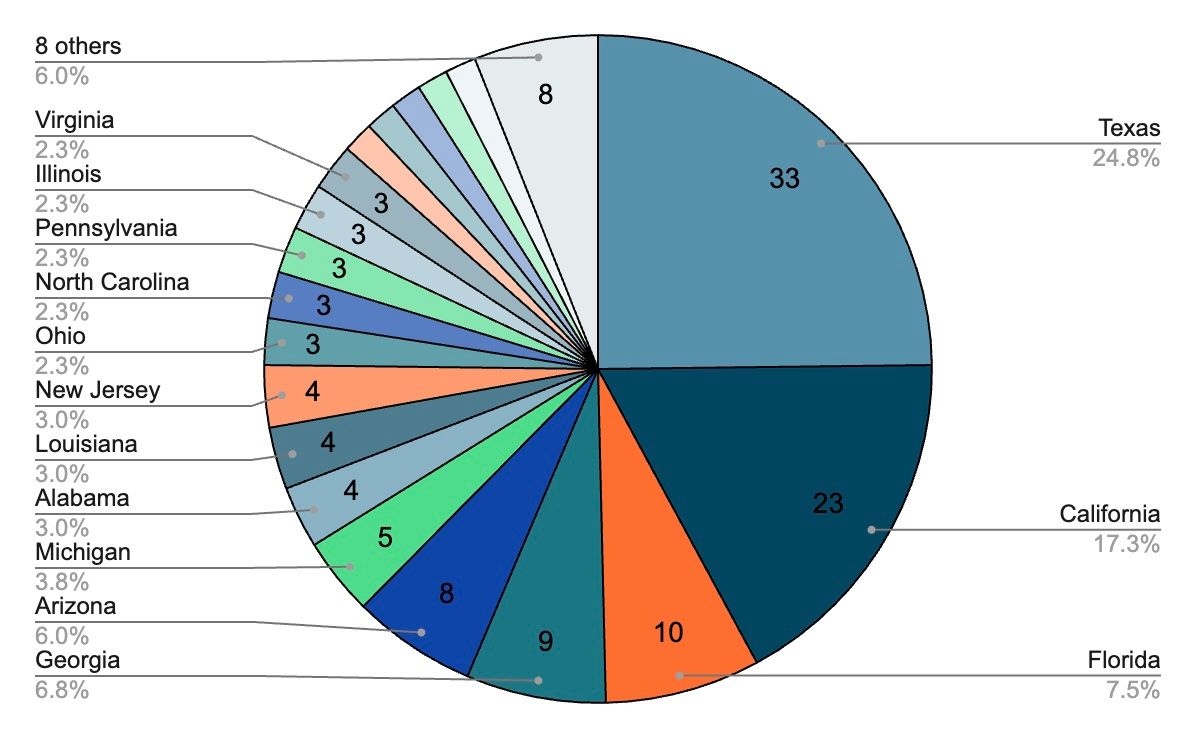
Kentucky, Maryland, New Mexico, Oregon and Utah each produced two 2025 FBS QB1s, while eight states produced one. Twenty-three states did not produce a starting quarterback.
What about recruiting rankings?
Coaches swear they don't look at them, or if they do they certainly don't use them as an evaluating tool, but the rest of us aren't coaches. The recruiting services and the coaching industry generally come to a consensus on each class's crop of quarterbacks -- it's rare to see Alabama, Georgia and Ohio State all offer the same 3-star, and even rarer that Eastern Michigan and Middle Tennessee are a 5-star's only offers -- and the numbers show most FBS QB1s are found in the glut of "good, not great" prospects. The overwhelming majority are low 4-stars and 3-stars, with extremes found at the top and bottom of the spectrum.
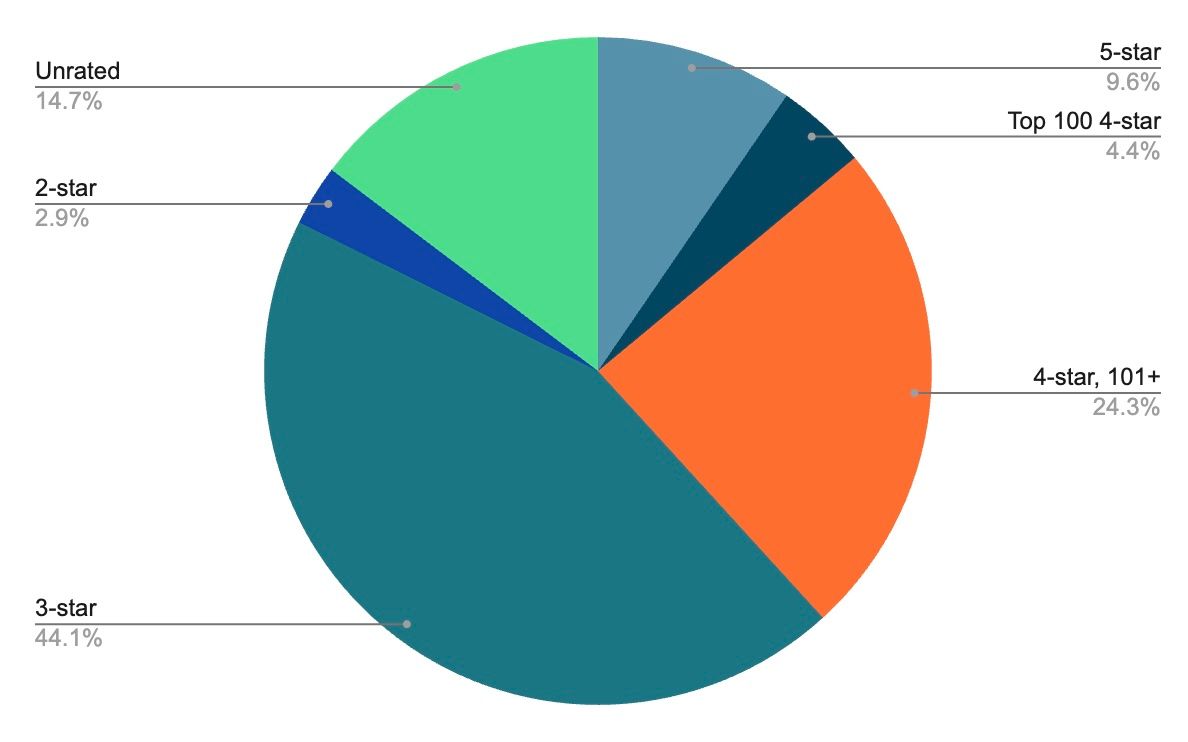
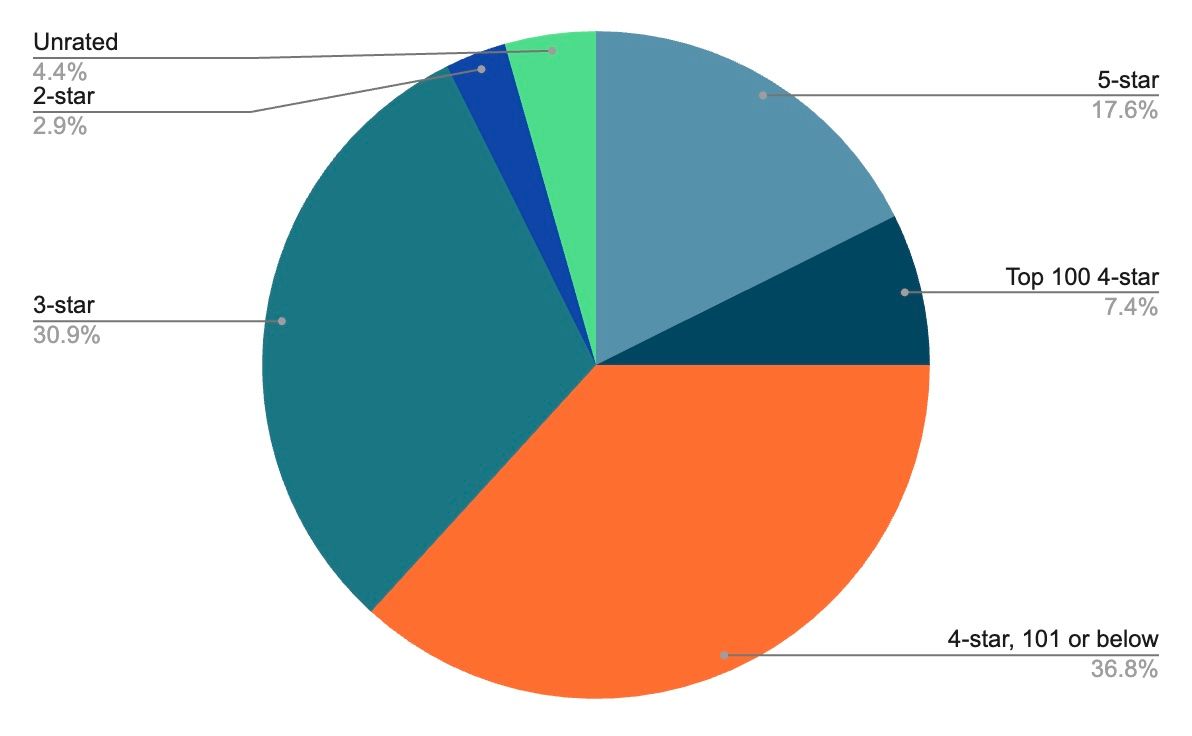
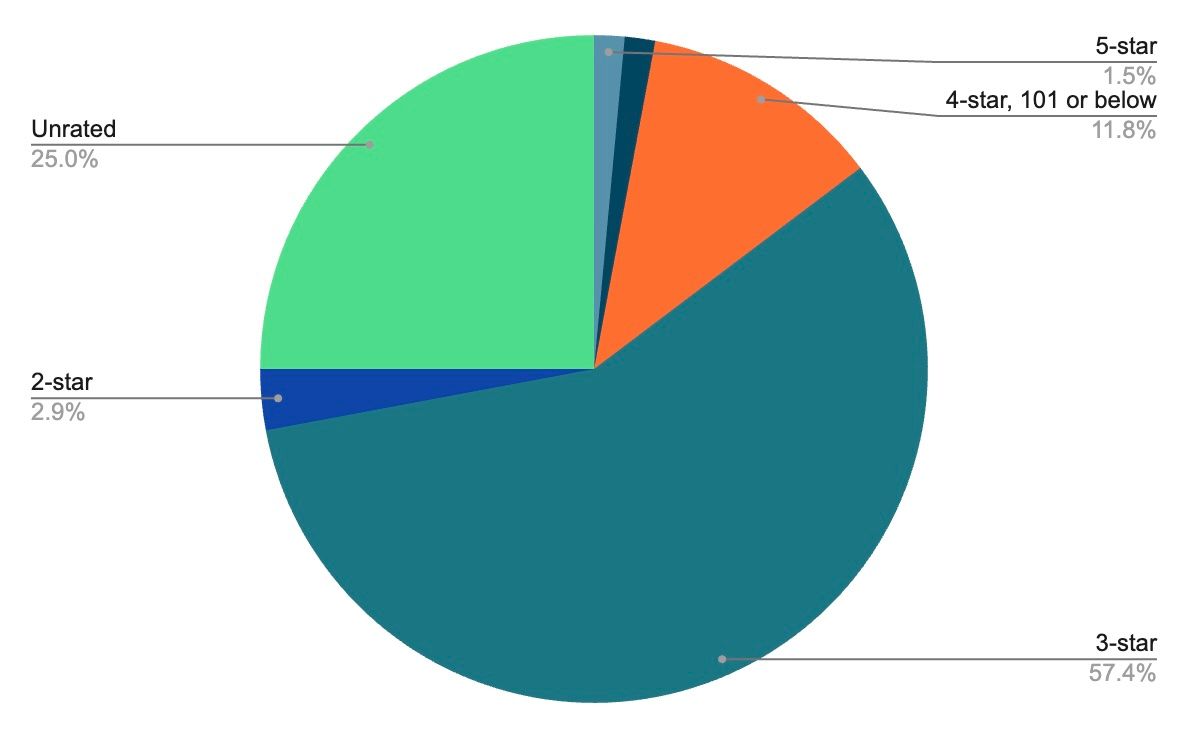
Within that those numbers are a stratification. Power 4 QBs are generally higher-rated recruits than their G5 counterparts. The two blue-chips starting at the G5 level in 2025 are UTEP's Malachi Nelson, a 5-star who was passed over at USC and Boise State, and Louisiana's Walker Howard, a top-100 4-star with stops at LSU and Ole Miss.
Power 4 starting quarterbacks as recruits:
Group of 5 starting quarterbacks as recruits:
Okay, so once a quarterback has been identified and signed, what happens next?
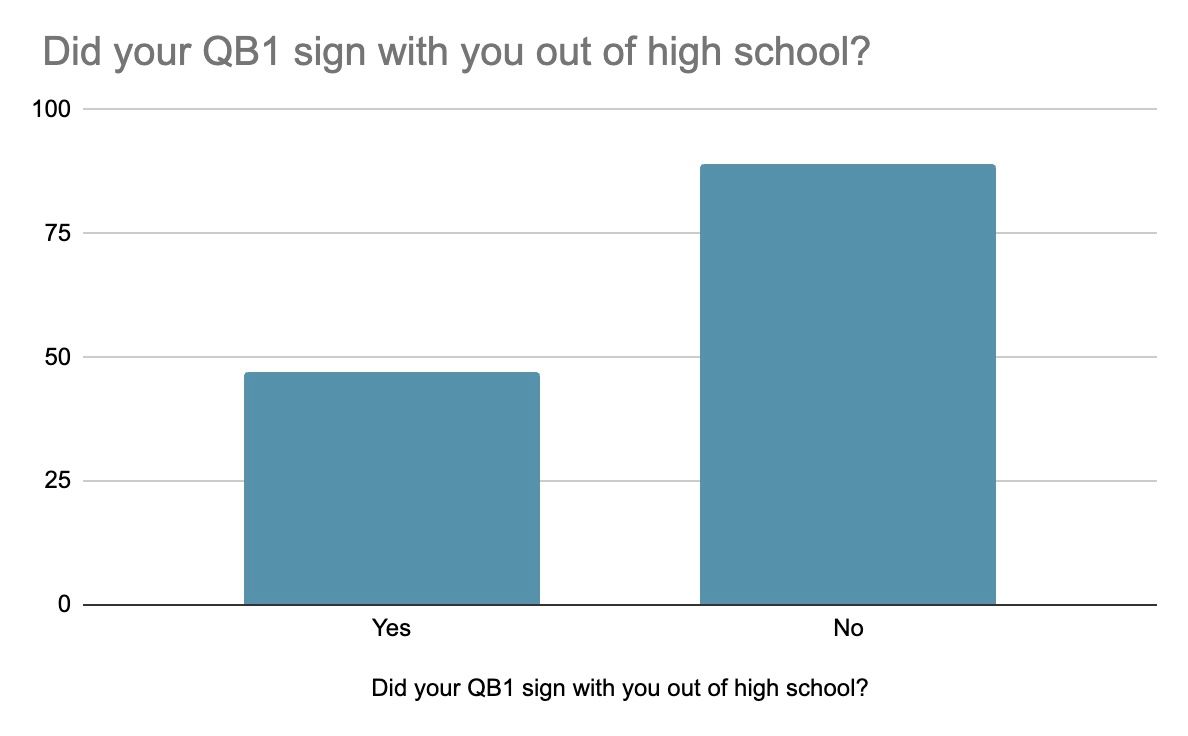
The numbers show that, more often than not, an FBS quarterback will have to find a starting job at a different school than he signed with out of high school. Nearly two-thirds of FBS QB1s (89) did not sign with their current school out of high school.
Also, the majority of college quarterbacks will not slide into a starting role. In fact, very few do.
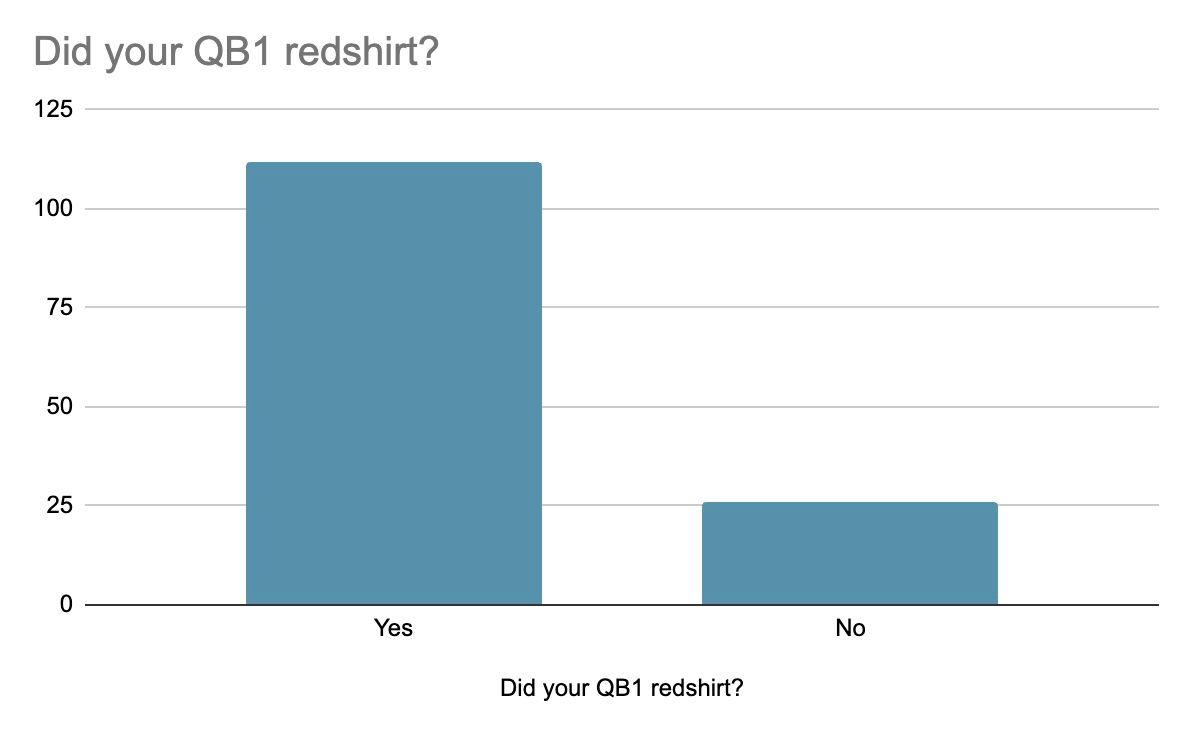
Hence, the typical FBS quarterback is in his third, fourth or fifth year of college football. There are more sixth-year starters than true freshmen.
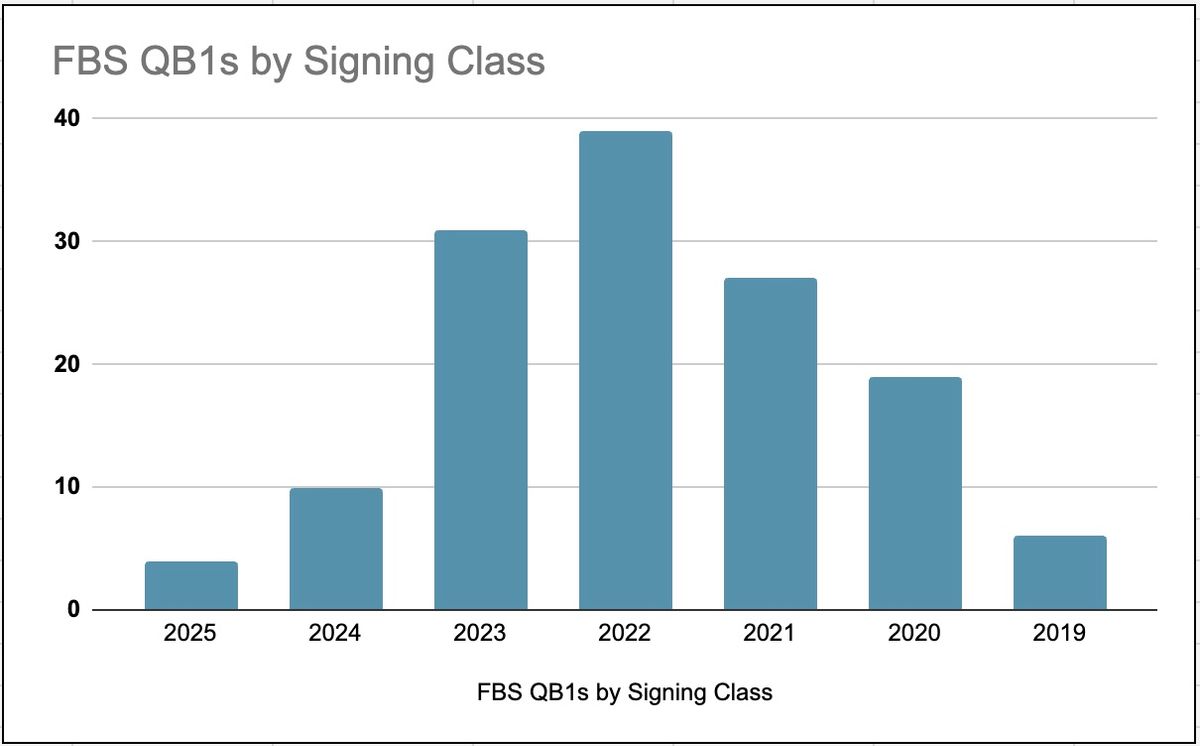
In perhaps the most "college football in 2025" stat I discovered, two of the four Class of 2025 starters did not sign with their respective schools out of high schools. Somehow, even the true freshmen are just as likely to be transfers than homegrown products.
So if I'm a high school quarterback dreaming of playing at the big time, it probably doesn't matter where I sign, right? Even if I have to wear a 'shirt as a freshman, in today's free-market environment, so long as I prove I can ball on the field, the big-time schools will find me.
Wrong.
The numbers show it is incredibly important for an FBS quarterback to sign with a Power 4 school out of high school, even if he doesn't wind up playing there. The MAC and Conference USA start more Power 4 signees (12) than G5 signees (8), and the American is close. Junior college quarterbacks have a decent shot of playing their way onto FBS rosters (if you count 3.67 percent decent), but quarterbacks who sign with 4-year schools below the FBS level almost never do. Of the six FBS QB1s in 2025, three come with asterisks:
-- Delaware's Nick Minicucci moved up to FBS with his program
-- New Mexico's Jack Layne followed head coach Jason Eck from Idaho to New Mexico
-- Iowa's Mark Gronowski had one of the best careers in FCS history (he won the FCS equivalent of the Heisman and was MVP of South Dakota State's win in the 2022 FCS national title game) to earn his spot on Iowa's roster.
Only one FBS starter began his career his career in Division II, Division III or NAIA: Arkansas-Monticello signee-turned-Sam Houston starter Hunter Watson, and he made a stop at a JuCo between Division II and FBS.
There are undoubtedly plenty of FCS, D2, D3 and NAIA quarterbacks who can play at the FBS level, but FBS coaches simply don't shop on that aisle of the grocery store.
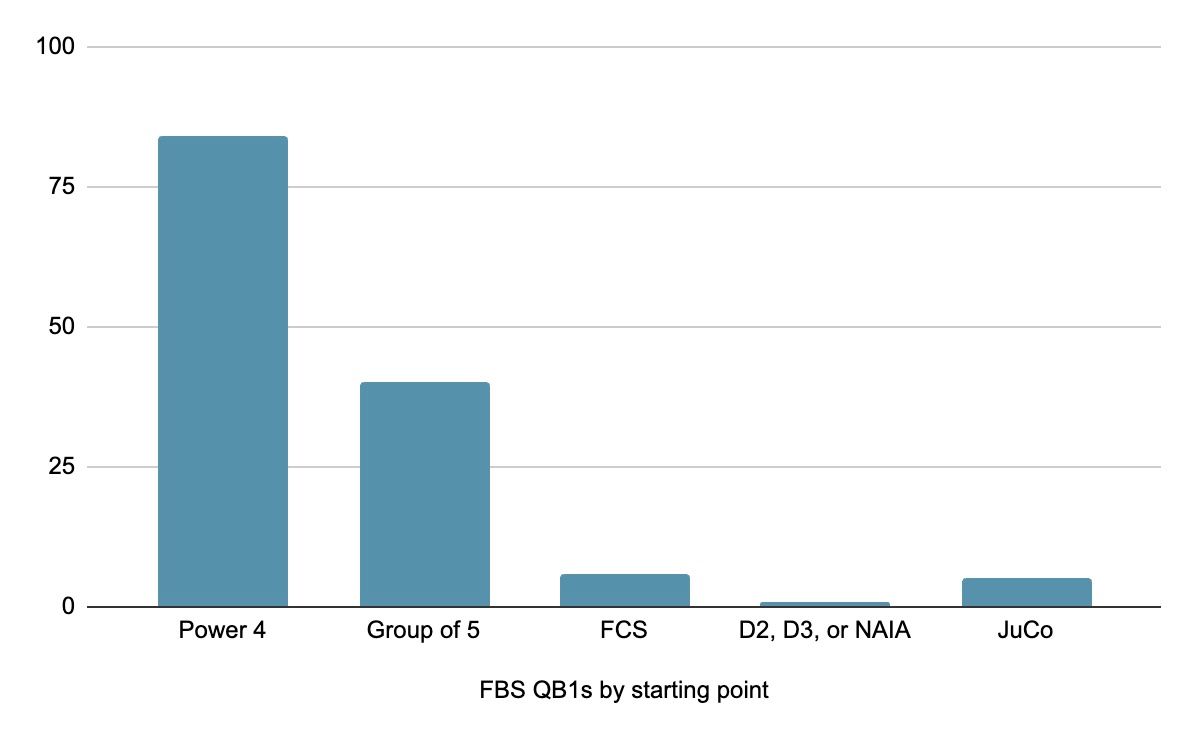
So, if you're a Group of 5 coach frustrated that your QB recruit seems to be holding out for a P4 offer rather than commit to you, don't be. The numbers show you're more likely to start a P4 transfer over him anyway, and he knows it.
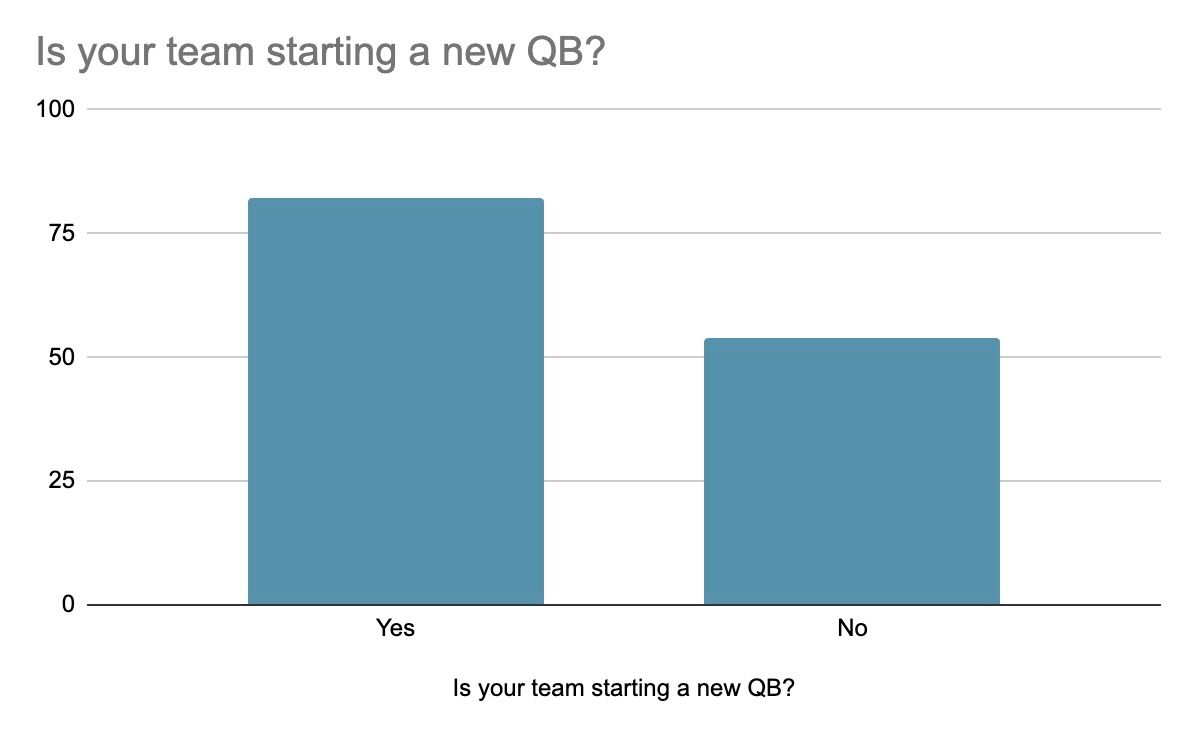
Add it all together, and college football at the FBS level is a sport that has to start over at the quarterback position more often than not. If most teams are playing a Year 1 starter, that's going to have a downstream effect on the rest of the sport, even the NFL. If a coordinator has to break in a new QB every year, the rest of the offense is running a simplified offense, and defenders may or may not be forced to defend higher-level concepts they would see at the NFL level.
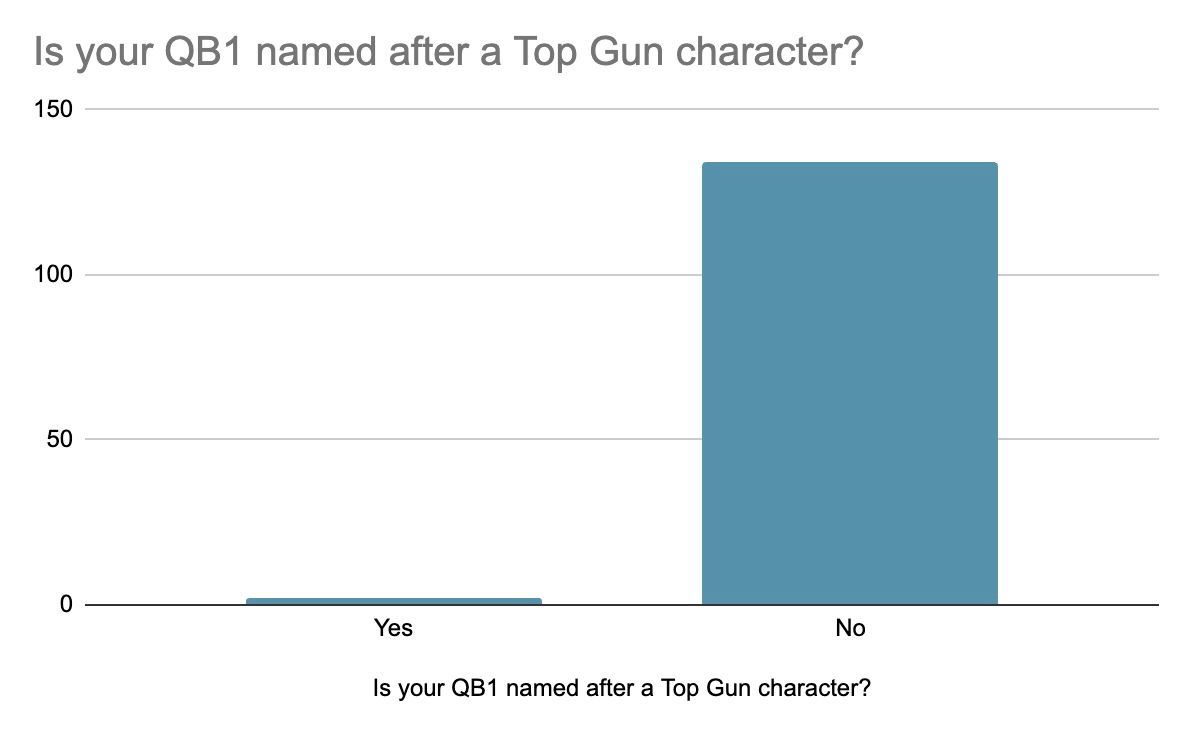
Finally, studying 136 FBS starting quarterbacks inevitably leads to some interesting finds. For instance, Troy starts a quarterback named Goose (a 2021 signee to West Virginia) and Western Kentucky starts a QB named Maverick (a 2019 Texas Tech signee, by way of Abilene Christian).
In conclusion, every FBS quarterback wants to be Cade Klubnik, DJ Lagway or Arch Manning, and every coach wants to sign one of them. An elite-of-the-elite prospect who signs with a championship contender with a clear path to the field, even if it may require waiting longer than you may otherwise want. Player or coach, who wouldn't sign up for that?
In reality, the median quarterback recruit's career probably plays out closer to Katin Houser's. Starring for SoCal prep power St. John Bosco, Houser was a mid 4-star recruit in the class of 2022. I don't know Houser, but I'm guessing he grew up dreaming of playing for USC, Notre Dame, or another blue-blood. He almost certainly would not have taken an in-home visit from East Carolina, but that's where he found himself transferring in 2024 after a coaching change pushed him out after two seasons at Michigan State. Houser didn't initially win the job out of camp at ECU -- he had to wait out a higher-rated prospect, Jake Garcia -- but now is entrenched as a second-year starter as a fourth-year player at his 65th-choice school out of high school.
Houser is playing, just not as quickly and not with the logo he envisioned as a high schooler. Such is the life of an FBS QB1 in 2025.