
As humans, our favorite lie we tell ourselves is that technology can wring perfection out of a human, and thus inherently flawed, process. When technology does not deliver the perfect results we believe we are owed, the solution is always to insert even more technology into the process.
That's what's happened with officiating in sports. Technology was supposed to make calls more accurate. That hasn't happened, and so now we demand even more technology to officiate games.
The latest example is currently embroiling the SEC in controversy. Calls in Saturday's Texas-Missouri game have, somehow, led commissioner Greg Sankey to go on SEC Network to make not-so-veiled shots at ESPN's Jesse Palmer. Everyone is having a good time.
Let's back up. By far the most controversial call came on a 3rd-and-10 with Mizzou leading 20-13 late in the third quarter. An Arch Manning pass that looked to the naked eye (and to the players on the field) like a standard-issue incompletion was ruled a fumble on the field. As we've learned over the years, this is the right move by the officials: they can always turn a fumble into an incompletion upon review, but they can't turn an incompletion into a fumble. Except, to the surprise of everyone, replay upheld the fumble.
Texas tied the game three plays later and ultimately won 34-20. As this video details, there were four questionable replay decisions in the game: the above play that went against Mizzou, a non-fumble that went against Texas, a reversal of a Mizzou touchdown catch that appeared to be the correct call, and a reversal of a 3rd-and-7 completion by Mizzou that appears to be a bad call against the Tigers.
Here are all the controversial calls from the Texas / Missouri game pic.twitter.com/DTeCroXzTe
— MD (@mike_daddino) November 7, 2026
"I'm just going to say this," ESPN's Jesse Palmer said after the Manning fumble. "No skin in the game. If you are a Missouri fan, you are Eli Drinkwitz, you are livid because it does feel like a lot of these calls are going against Missouri today." While that may not read as an incendiary quote on the page, one doesn't need a Master's degree in English literature to pick up on the subtext of that statement.
Then, Missouri AD Vaird Leatch published an open letter to Tigers fans in which he requested a "formal review and response" from the SEC. While careful to say he didn't pin the loss on the refs or feel like Missouri was the victim of a conspiracy, Leatch zeroed in on something many called for in the wake of the Texas-Missouri game: Why is the SEC not following other conferences in letting viewers hear deliberations on reviews?
"This experience has reinforced my belief that our lack of transparency in the replay booth, particularly when other conferences have taken steps to provide it, allows for an environment of speculation and mistrust," Leach said. "Together with President Choi, we will be strong advocates for that change within the SEC this offseason."
Appearing on Paul Finebaum's show Monday -- in person, no less -- Sankey said the SEC was simultaneously too important and not equipped to put mics on the unidentified bureaucrats making decisions from an office in Birmingham that decide these games. He then turned his sights on ESPN's broadcasters and the former officials ESPN brings on (one of whom happens to be former SEC and NCAA officiating chief Steve Shaw) for not knowing what they're talking about. That's all paraphrased, but only slightly.
"Some of the worst 'officials' in America are those in the announce booth."
— Paul Finebaum (@finebaum) November 9, 2026
"I am highly disappointed in the announcers."
Greg Sankey vehemently defends the SEC's officiating and details planned improvements: pic.twitter.com/eFCIQgWKzp
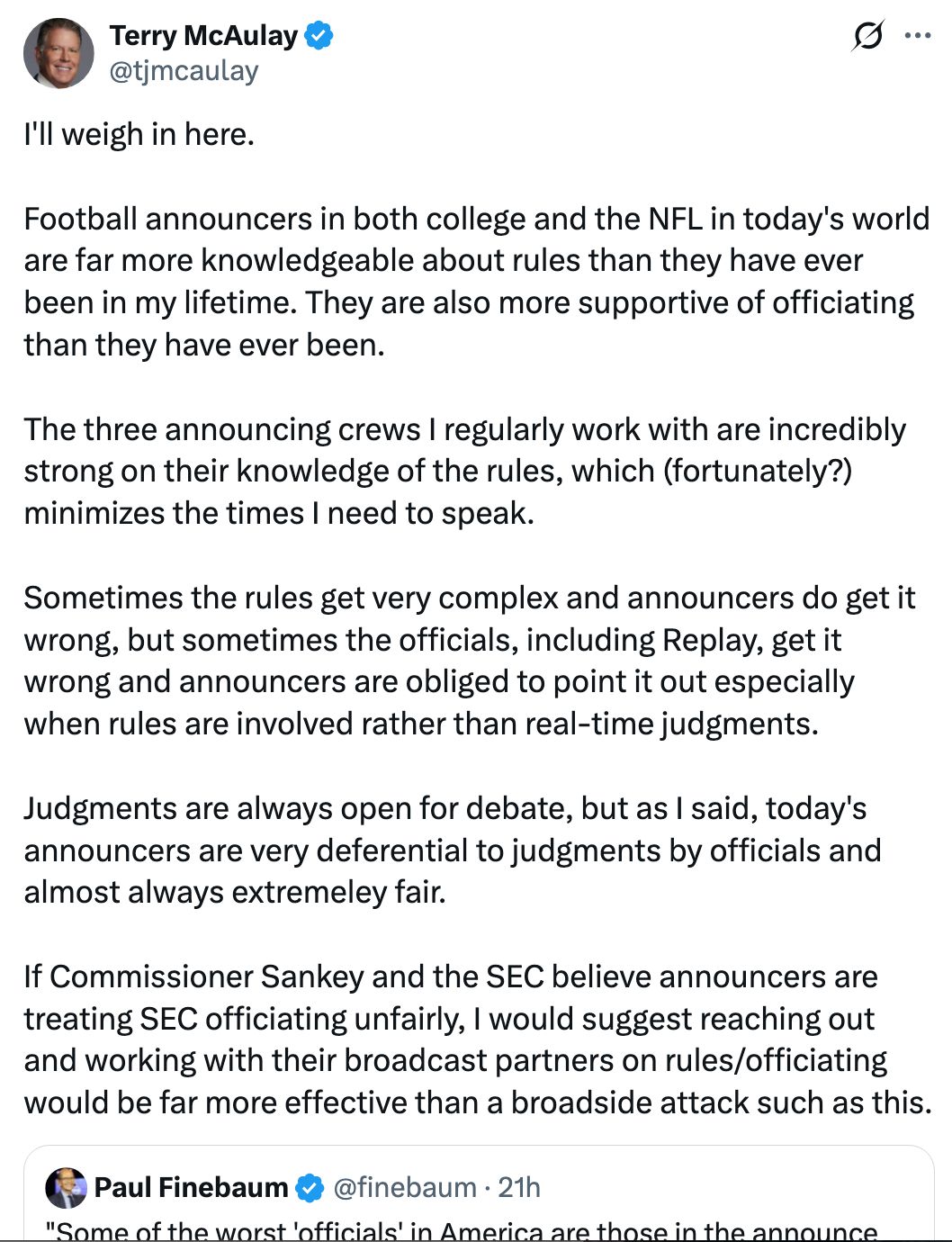
"Sometimes the rules get very complex and announcers do get it wrong, but sometimes the officials, including Replay, get it wrong and announcers are obliged to point it out especially when rules are involved rather than real-time judgments," NBC rules analyst and prolific tweeter Terry McAuley tweeted Tuesday morning. "If Commissioner Sankey and the SEC believe announcers are treating SEC officiating unfairly, I would suggest reaching out and working with their broadcast partners on rules/officiating would be far more effective than a broadside attack such as this."
By inserting technology into the officiating process, final authority has been taken away from the officials on the field and given to people that no one can see or identify, while an endless pursuit of perfection has led for calls for more technology.
The SEC will likely figure out a way to mic up its replay command center this offseason, and in 2027 we'll be back to complaining why this process we've told ourselves is perfect still isn't producing perfect results.