
In 2006, the Big Ten and the Fox Corporation began their partnership to create the Big Ten Network. The goal was to broaden the conference's appeal by airing games that otherwise wouldn't have been on TV, and make money along the way. The plan has since changed.
Twenty years later, Fox and the Big Ten have completely remade the map of college athletics, and now the goal is to fundamentally alter college football as we knew it for more than 150 years.
Before we get to where we're going, let's first remember where we've been: Realignment crash course.
At the time of BTN's launch, the Big Ten was one of six roughly-equal power leagues. I say roughly equal because the Big East, which launched football in 1991, forever lost its shot at equal footing when Penn State became the Big Ten's 11th member in 1991. With that move, the Big Ten accomplished two things: 1) it weakened a potential rival, and 2) it broke away from the idea that a conference's name was bound by common sense. Nevertheless, BTN's success beginning in 2007 pushed the conference to increase its profits through expansion. Since then, the Big Ten has taken from every single one of its peers except the SEC.
The conference opened the floodgates by swiping Nebraska from the Big 12 in 2010, then defied all sense in search of dollars and cents by acquiring Maryland from the ACC and Rutgers from the American (formerly Big East) in 2012. Over time the logic for realignment changed, and in 2024 the Big Ten sent a death blow to its former partner conference out west by acquiring UCLA, USC, Oregon and Washington.
Of course, the Big Ten wasn't the only conference to take a predatory stance toward a peer, but they've often been the first, the most aggressive, and the most brazen.
The Big Ten and Fox's evolving relationship.
At launch, the Big Ten owned 51 percent of BTN, and Fox 49 percent. Over time, the ratio has flipped, and Fox now owns 61 percent to the Big Ten's 39.
But cable TV is now less important today than it was in the 2000s, and so the best metric to understand the network and the conference's relationship is through its most recent round of media rights negotiations. In signing an NFL-like deal with Fox, CBS and NBC, the latter two networks negotiated their respective contracts with Fox sitting on the Big Ten's side of the table.
Does this sound like a partnership to you, or an owner/property relationship?
Now consider that, for better or worse, Fox has built its college football strategy around owning the Saturday noon window and, increasingly, playing games on Friday nights. This means Ohio State and Michigan fans have to plan around every big or even medium game kicking at noon, while Rutgers may have to kick at 11 p.m. on a Friday.
Where we're going next. Fox built its sports strategy and, indeed, its entire TV empire off of owning as much of the Cowboys, Packers and 49ers as possible, and its college football strategy is built around replicating that success, with zero regard to how it affects college football, and college athletics, as a whole.
Fox wants to nationalize college football because its believes there's more money in catering to casuals than serving diehards. It wants to trade USC-Oregon State for USC-Ohio State, and doesn't care if it requires shipping UCLA softball to Ann Arbor or completely crushes Oregon State in the process.
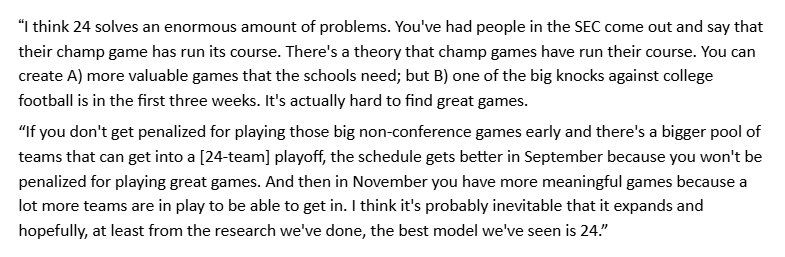
Now, let's apply that to the CFP. Here's what Fox Sports CEO Eric Shanks said Thursday, via Sports Business Journal:
Ben Portnoy on Twitter
null
Before we go further, I want to state that Shanks is not exactly wrong in connecting any of these dots, nor is he alone in coming to these conclusions. Plenty of administrators, coaches and fans have said the same on their own. In Shanks's mind, he's simply working to give the people what they want and make some money along the way. I'm just trying to lay out the consequences of the changes he's pushing to institute.
No one's going to turn down more meaningful games in September, but keep in mind the balance of the see-saw. If every game is "meaningful," eventually none of them are. Texas-Ohio State was a frenzy simply because of the stakes involved. In the olden days, the loser would've had to walk a tightrope uphill all season long to remain in the hunt for the national title. The stakes aren't quite as high as they were in the 1990s and 2000s, but Texas still missed the CFP at 9-3 in part because of that loss. If there's no penalty for losing in non-conference, there's no meaning in those games, either.
The meaning Shanks is trying to add to November are the seventh, eighth, and ninth place B1G and SEC teams playing for the 22nd and 23rd seeds in a 24-team tournament. It's this, but with the 5-4 Wisconsin and Minnesota IN THE HUNT.
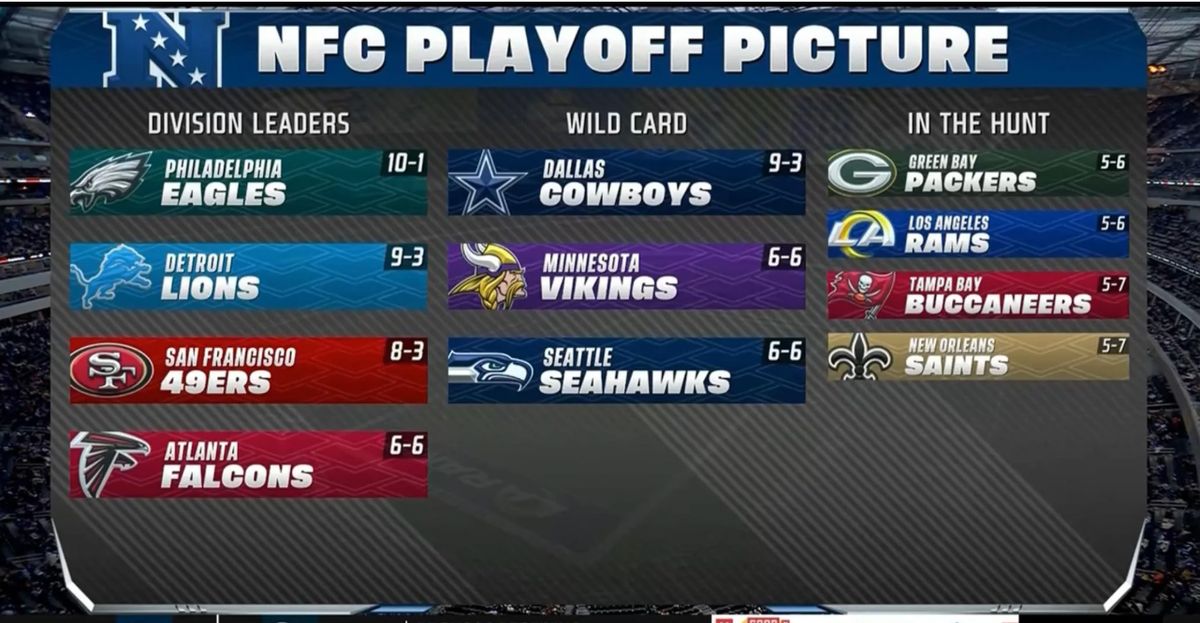
Reducing the stakes for non-conference games and lowering the bar for CFP participation would keep more people invested in college football for longer, I have no doubt about that. It would also turn college football into an entirely different sport than what it used to be, and I have serious doubts Fox or the Big Ten care.