
The North Texas offense was an irresistible force in the 2025 college football season. Former walk-on quarterback Drew Mestemaker was a revelation as a first-time starter, leading the nation in passing while setting a single-game American Athletic Conference record with a 608-yard performance at Charlotte in October, while true freshman running back Caleb Hawkins led the nation with 25 rushing touchdowns (plus four receiving).
Except, as the Mean Green offense overwhelmed opponent after opponent in 2025, North Texas left opposing defense less, ahem, whelmed than similar offenses in years past.
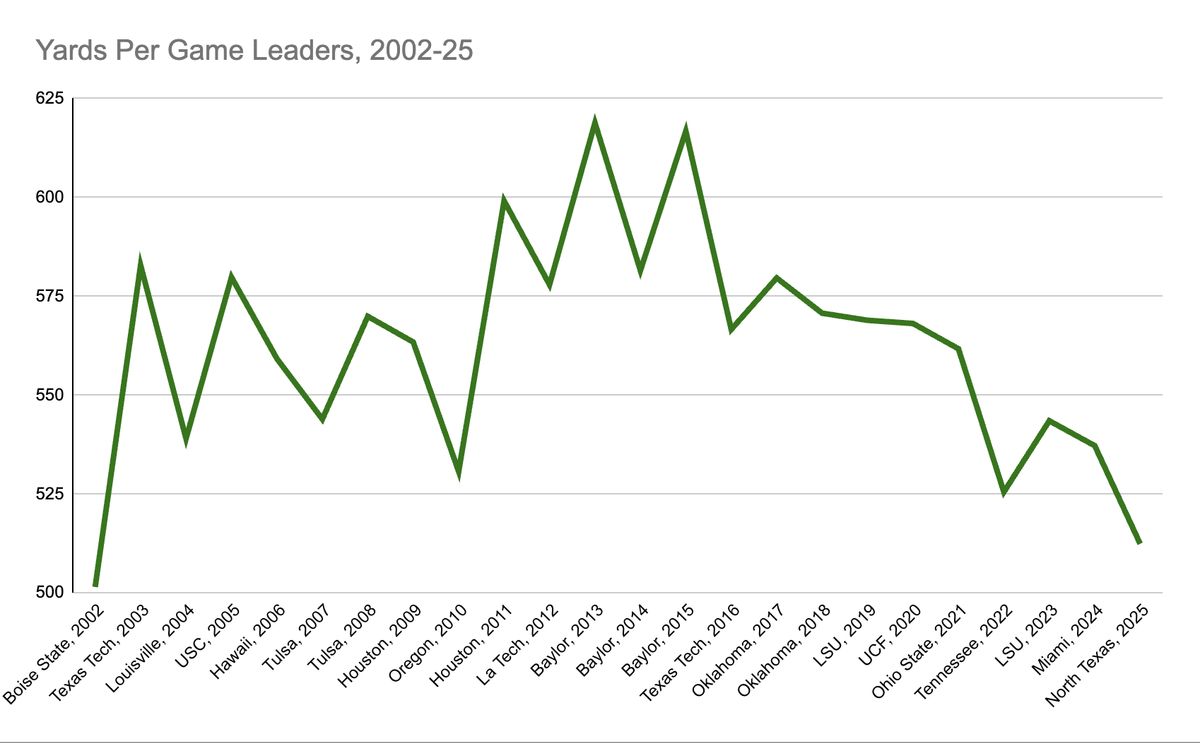
North Texas averaged a national-best 512.4 yards per game in 2025, which would have finished a distant third in 2024. And 2023. And 2022. That 512.4 figure would've been good for fourth in 2021, sixth in 2019, and just a tick above eighth in 2018. The 2025 Mean Green would've finished outside the top 10 in 2016.
As far as national leaders go, UNT's 512.4 yards per game are the fewest since Boise State's 501.5 yards per game led the nation in 2002. "That's a long time," Eric Morris chuckled.
Of course, we're not picking on the Mean Green here. They were the best of the bunch, after all: the only team to even surpass the 500-yard per game mark in FBS, the first time that's happened since 2006. Consider: 54 teams averaged at least 400 yards per game last season; 71 did so in the Peak Offense season of 2013, and 67 did so as recently as 2021. Interestingly, the 400-yards-per-game club has held eerily steady of late: exactly 54 teams have averaged 400 yards over the past three seasons, and 55 did so in 2022.
"I've always thought football goes in waves and history repeats itself. I think people are managing the game more defensive-minded. Watching some of the Big 12 from last year and looking ahead, so much more 12 personnel, 13 personnel. Slowing things down, running the ball," Morris, now the Oklahoma State head coach, said Monday morning on spring break vacation from Hawaii.
2002 was the late Leach's third season at Texas Tech. Behind senior quarterback Kliff Kingsbury, the Red Raiders won nine regular season games and played for the Big 12 South title in their regular season finale. That "proof of concept" season led to the Air Raid taking over the sport. Within a dozen years, Baylor was routinely averaging 600 yards per game, and a Big 12 team led the nation annually in yardage from 2013-18, with around 570 yards per game the minimum.
The trend line changed, like so many other things in life, after covid. The national leader averaged at least 560 yards from 2011-21; since 2022, not a single team has produced more than 543.5 yards per game.
"You heard Nick Saban's comments a couple years back -- playing great defense and scoring 20 points a game wasn't enough anymore," Morris said. "Defensive disguises have gotten a lot better. People are figuring out these RPOs."
Football schematics are the ultimate proof of Newton's Third Law of Motion: every action has an equal and opposite reaction. And so while defenses have gotten better at disguising their looks, offenses have put more emphasis on disguising their own looks and changing things pre-snap to put the numbers in their advantage. The effect, in turn, is that per-game yardage averages drop even further. "I think motioning is become more and more a thing, and it takes time to motion," Morris said. "Everybody's motion and shifting."
In Morris's case, that also meant running the ball more. North Texas ran the ball on 52 percent of its 992 snaps. That allowed the Mean Green to lead the nation in total offense at just 70.9 snaps per game, a nearly identical rate as Miami in 2024. A decade ago, Texas Tech needed nearly 87 snaps to put up 566.6 yards per game.
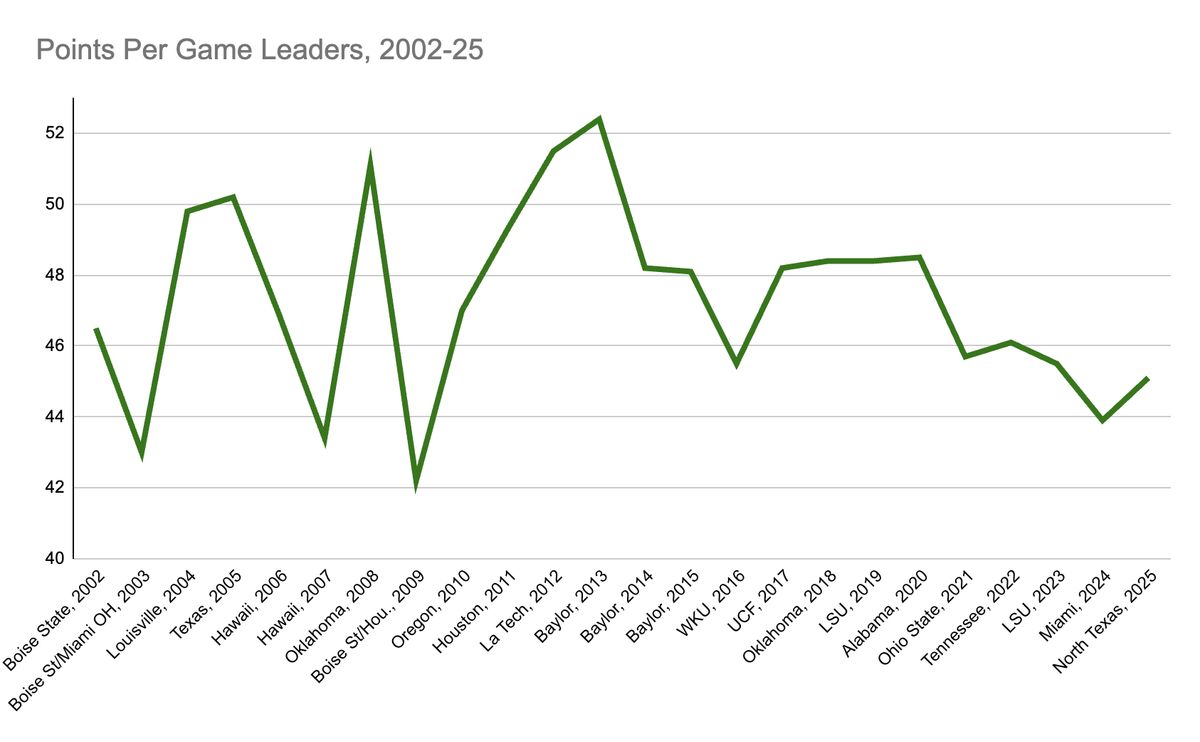
The upshot of all this is while total yardage has fallen off the proverbial cliff, scoring has not.
For instance, while averaging "only" 512.4 yards in 2025, North Texas still scored 45.1 points per game. What that means is that while UNT gained 90 percent of the yardage that Texas Tech did to lead the nation in 2016, they scored 99 percent of the points that 2016 national-leader Western Kentucky did (45.4) that same season.
"We were really intentional this year, going back and scouting ourselves. Our yardage was there and we weren't really as good at scoring points. We wanted our red zone percentages to go up, and our third down and fourth down. We're a big fourth down team. We want to be efficient on third and fourth, turning that 3rd-and-8 into a fourth down opportunity. We drastically improved in those categories -- that's something we spent a lot of time on, and it was good to see that come to light," Morris said. "We changed the way we game-planned."
North Texas attempted 36 fourth downs across its 14 games, which tied for 12th nationally. Nationally, 43 teams attempted at least 30 fourth downs in 2025; 14 teams did so in 2016, and 26 did in 2021.
With the number of possessions down across the nation, coaches are putting more into maximizing each of them at the expense of their snap and yardage numbers.