
A report released by the NCAA Wednesday showed that athletes who transfer more than once are close to 20 percent less likely to graduate than those who remain at their original school.
The organization studied nearly 36,000 Division I athletes from all sports beginning with the 2018-19 academic year. This was the cohort that had their college careers disrupted by covid, and the transfer portal, and NIL.
According to the NCAA's data, 88 percent of all D1 athletes who never transferred graduated within six years, 81 percent who transferred once graduated, while 71 percent of athletes who transferred two or more times did the same. Among men, the numbers were 84-77-69. Broken down by race (both genders), Black student athletes graduated at 82-74-62 rates, white student-athletes were at 92-85-78, and all others were 84-81-71.
Most striking, only 58 percent of FBS players who transferred twice or more graduated, compared to 76 percent who transferred once and 85 percent who never did. In FCS, the numbers were 83-73-62.
"Regardless of race, gender or sport, multiple transfers typically graduated at rates 10 percentage points lower than peers who transferredonce and 15-20 percentage points lower than peers who never transferred," the NCAA said.
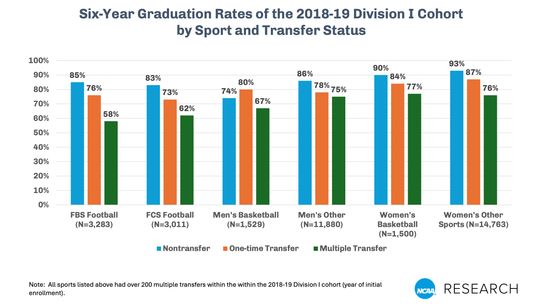
The NCAA briefly enforced a 1-time transfer limit for all undergraduate athletes in 2023, but that was overturned when a group of state attorneys general sued under the Sherman Act. In April 2024, the NCAA Division I Board of Directors, at legislative gunpoint, voted to make multi-time transfers immediately eligible. The push by state lawmakers and lawyers undoubtedly won some games put money in college athletes' pockets, but inadvertently harmed their ability to earn a college degree.
Necessary disclaimer: Transfer decisions are too often not made by the athlete, but instead by an adult in the athlete's circle who ostensibly has the athlete's best interest at heart, be it a coach, representative, or parent.
There are, of course, stories of a second, third or fourth transfer that worked out, times when an athlete stayed put at his or her original school and paid the price for it, or the athlete wanted to remain at their original school but couldn't due to circumstances beyond their control.
But the data clearly show that most college athletes will go pro in something other than sports, and most of them are better off in the long run remaining at the school they signed with out of high school.