
The quarterback position has long been an industry within an industry. But as the game of football has gained more and more market share over America's attention in recent years, the financial stakes have never been higher.
Seven NFL quarterbacks will make at least $50 million this fall, and the leader of the group, Patrick Mahomes, will cross $700 million in on-field earnings by 2033. It is a mathematical certainty that a quarterback not currently of legal drinking age will one day reach $1 billion in on-field earnings alone, likely multiple.
Far more attainable are the NIL contracts awarded to the highest-paid quarterbacks in college football, where total commitments reach eight figures and $1 million represents the low end, at least at the Power 4 level.
But as the pot of gold on the other side of the rainbow has never been bigger, the path to get there has never been more treacherous. If you're looking for a guaranteed path, it's this: be 6-foot-4 and the grandson and nephew of former NFL quarterbacks. For everyone else, consider this: the consensus best quarterback in college football in 2026 is listed at 6-foot-even on a good day, and in his senior year of high school threw for all of 1,610 yards before beginning his college journey at the Division II level.
The QB industry faced an inflection point this past weekend. After months of practice, years of training, and countless prayers from Mom and Dad, 138 young men took the first snap of their team's season at the FBS level. While all 138 paths are slightly different, we can learn a thing or three in studying how they got there.
POINT 1: HOW MANY FBS SCHOOLS START TRANSFERS?
The top line number: 50 of the 138 Football Bowl Subdivision schools start quarterbacks they signed out of high school, roughly 35 percent. The number is skewed toward the Power 4, but only slightly: 26 of the 68 P4 schools start homegrown products, compared to 33 percent of the Group of 6 (23 of 70). The SEC, Conference USA and the Pac-12 are the only conferences to touch 50 percent, while the American is the most reliant on free agents at 85 percent.
ACC: 6 of 18 signed out of high school (including Notre Dame)
Big 12: 5 of 16 signed out of high school
Big Ten: 7 of 18 signed out of high school
SEC: 8 of 16 signed out of high school
Eleven Power 4 starters are multi-time transfers, but of those 11, the ACC (five) and Big Ten (four) account for nearly all of them. The Big 12 and SEC start just one frequent flier apiece.
American: 2 of 14 signed out of high school
Conference USA: 5 of 10 signed out of high school
MAC: 4 of 13 signed out of high school
Mountain West: 4 of 10 signed out of high school
Pac-12: 4 of 8 signed out of high school
Sun Belt: 4 of 14 signed out of high school
22 Group of 6 starters are multi-time transfers, and two of the homegrown products (Carson Conklin, Sacramento State; McCae Hillstead, Utah State) transferred out, then transferred back to their original schools. These numbers would move even further in the direction of transfers if Akron's Reese Poffenbarger, a 6th-year player on his fourth school, had been ruled eligible by the NCAA; in his stead, Akron started redshirt freshman Cibastian Broughton (a Zips signee) against Wake Forest on Thursday while waiting on a final ruling on Poffenbarger.
POINT 2: STARS AREN'T EVERYTHING (BUT CONTEXT MATTERS)
Over half of FBS starters were 3-stars in high school, and twice as many carried zero stars with them to college than five.
5-star: 10
4-star: 32
3-star: 72
Unrated: 24
This section could be subtitled "An introduction to the concept known as the bell curve." High school football produces thousands of unrated quarterbacks per class, hundreds of 3-stars, dozens of 4-stars, and a handful of 5-stars. In fact, there are 20 5-stars playing college football right now -- half of them start, and of the remaining 10, six are true or redshirt freshmen. In fact, here's a brief overview of the 10 5-star recruits not currently starting for FBS schools:
-- Devin Brown (class of 2022): starter at Weber State after signing with Ohio State and transferring to Cal
-- Malachi Nelson (2023): backup at Syracuse, with stops at Boise State and UTEP after signing with USC
-- Dylan Raiola (2024): backing up 5-star Dante Moore at Oregon after starting his first two seasons at Nebraska
-- Tavien St. Clair (2025): third-string at Ohio State, behind 5-star Julian Sayin
-- Husan Longstreet (2025): third-string at LSU
-- Deuce Knight (2025): backup at Ole Miss
-- Keisan Henderson (2026): backing up 5-star Conner Weigman at Houston
-- Jared Curtis (2026): lost training camp battle at Vanderbilt, backup
-- Dia Bell (2026): third-string behind 5-star Arch Manning at Texas
A 5-star ranking is a guarantee of future stardom. But remember the bell curve: there are countless 3-stars and unrated recruits who don't go on to win starting jobs, but we they don't get the "bust" label that 5-stars do.
Having said all that, a 3-star label for a quarterback recruit is not a death sentence, it's the most common starting point.
EXPERIENCE NECESSARY
FBS QBs by Signing Class
2026: 1
2025: 14
2024: 33
2023: 43
2022: 35
2021: 9
2020: 3
Tennessee's Faizon Brandon, the No. 10 player in the Rivals Industry Rankings, is the only class of 2026 member currently starting. Only 14 redshirt freshmen start as well. Again, the bell curve fattens around third-, fourth-, and fifth-year players, accounting for 111 of the 138 starters (80 percent).
Obviously, there's the caveat that many of those third-, fourth-, and fifth-year guys once started as freshmen and are now tenured in their respective positions. As a general rule, though, FBS programs are not entrusting the most important position on the field to a freshman and giving him leash to grow into the role. In the world of NIL, schools are paying for experience.
WHERE YOU SIGNED OUT OF HIGH SCHOOL STILL MATTERS
All FBS
Power 4: 75
Group of 6: 44
FCS: 13
Division II: 4
JuCo: 2
Power 4
Power 4: 52
Group of 6: 13
FCS: 1
Division II: 2
JuCo: 0
Group of 6
Power 4: 23
Group of 6: 31
FCS: 12
Division II: 2
JuCo: 2
Here's where we get into the Catch-22 of playing (or not playing) the position. The median FBS starter began this season with 11.5 career starts, but how do you get experience in the first place if it takes experience to see the field? If the typical FBS school is statistically more likely to import a quarterback than develop one, aren't you better off signing with a school where you can play immediately, thus gaining the experience required to play the position in the first place?
Maybe, maybe not.
Over half of FBS starters signed with Power 4 schools out of high school. Three-fourths of Power 4 starters began their careers at that level, and a third of Group of 6 starters did as well. I count 18 FBS schools that opened this season with a quarterback that had never started a game before (plus a bunch more with one, two or three, of course.) Of the 18, 12 were in the G6 and only six in the P4. Of those six, two started non-transfers: Faizon, the true freshman at Tennessee, and Alabama's Keelon Russell, the No. 2 player in the class of 2025.
Think of it this way: 5-stars are first-round picks in the NFL. They're otherworldly talented, the team that gets them is going to devote significant resources into playing them as early as feasible, and in the event they flame out, someone else is going to take a chance on them.
Everyone else is like a Major League Baseball draft pick. If you're talented enough to be drafted, you're talented enough to make it to the Show, but you're going to have to grind through a couple years of bus rides and PBJ sandwiches, and if/when you do make it, it probably won't be with the team that originally drafted you.
HUNTING GROUNDS: FBS QUARTERBACKS BY STATE
Again, we're not reinventing the wheel here. I count 32 individual states producing starting quarterbacks, concentrated in the four states that produce the most players at the 21 other positions as well.
20: Texas
17: California
14: Georgia
12: Florida
7: North Carolina, Michigan
6: Alabama
5: Tennessee
4: Louisiana, Ohio
3: Arizona, Illinois, Kentucky, Maryland, New Jersey, Utah, Virginia
2: Hawaii, Massachusetts, New York, Oklahoma, Oregon, Pennsylvania
1: Arkansas, Colorado, Iowa, Indiana, Kansas, Mississippi, Nevada, South Carolina, South Dakota
MISCELLANEOUS
What's in a name? The most common first initial for an FBS QB1 is "J," with 17 starters, followed by "C" (14), "A" (12), "D" (12), and "M" 11. Most common first names: Jayden and its variants (three), Caden (three), William (three). There are nine FBS quarterbacks whose first names end in "-den" or "-dan."
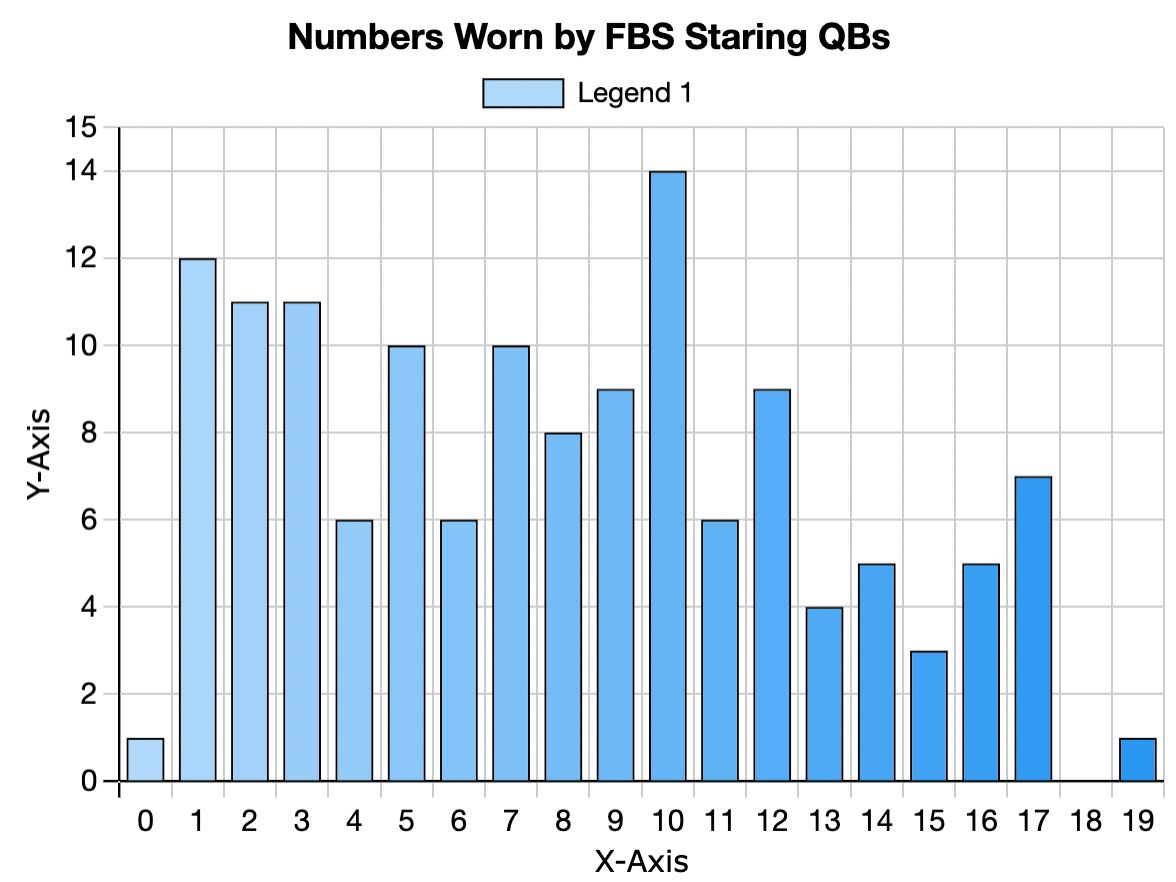
Fashion statements. The most common number chosen by FBS QB1s is 10, worn by 14 starters. However, the kids these days prefer single-digit numbers in aggregate. The only number between 0 and 19 unclaimed by any starter is 18, and Michigan's Bryce Underwood is the only starter brave enough to don 19. It remains a collective failure that no one has bullied BYU's Bear Bachmeier out of wearing 47.
CONCLUSION: WHO IS THE MEDIAN FBS STARTING QUARTERBACK?
Last year, we identified Katin Houser as the Median FBS Starting Quarterback. A 4-star recruit from a major metro area in a sunshine state (check), Houser signed with a Power 4 school out of high school (check). Houser signed with Michigan State, making him one of four active starting QBs to have spent time in East Lansing, the most in college football. A redshirt in 2022, he joined the starting lineup midway through his redshirt freshman season, but a 4-8 season brought about coaching change, and the new head coach had his own guy at quarterback. (Fittingly, neither guy is still at Michigan State.) Houser started nine games for East Carolina in 2024, and at this time last year was on his way to 12 starts for the Pirates.
A year later, Houser is now spending his final collegiate season at Illinois. Because of course he is.
On the other end of the development chain, there's Trey Owens. Like Houser, Owens was a 4-star ranked outside of the national top 250. He signed with Texas out of suburban Houston, knowing he'd back up Quinn Ewers and then Arch Manning. However, it was unlikely he'd win the derby to replace Manning and so, like Houser, he decamped for a school he likely wouldn't have given the time of day to back in high school -- Arkansas State. A first-time starter, Owens is a successful year or two away from bouncing back to the Power 4 before taking his shot at the NFL.
It's incredibly unlikely Houser or Owens will become football's first billionaire quarterback. But by transferring to schools they'd never imagined themselves at just a few years ago, both quarterbacks have kept the dream alive, and with health and good fortune they'll leave college football as millionaires.