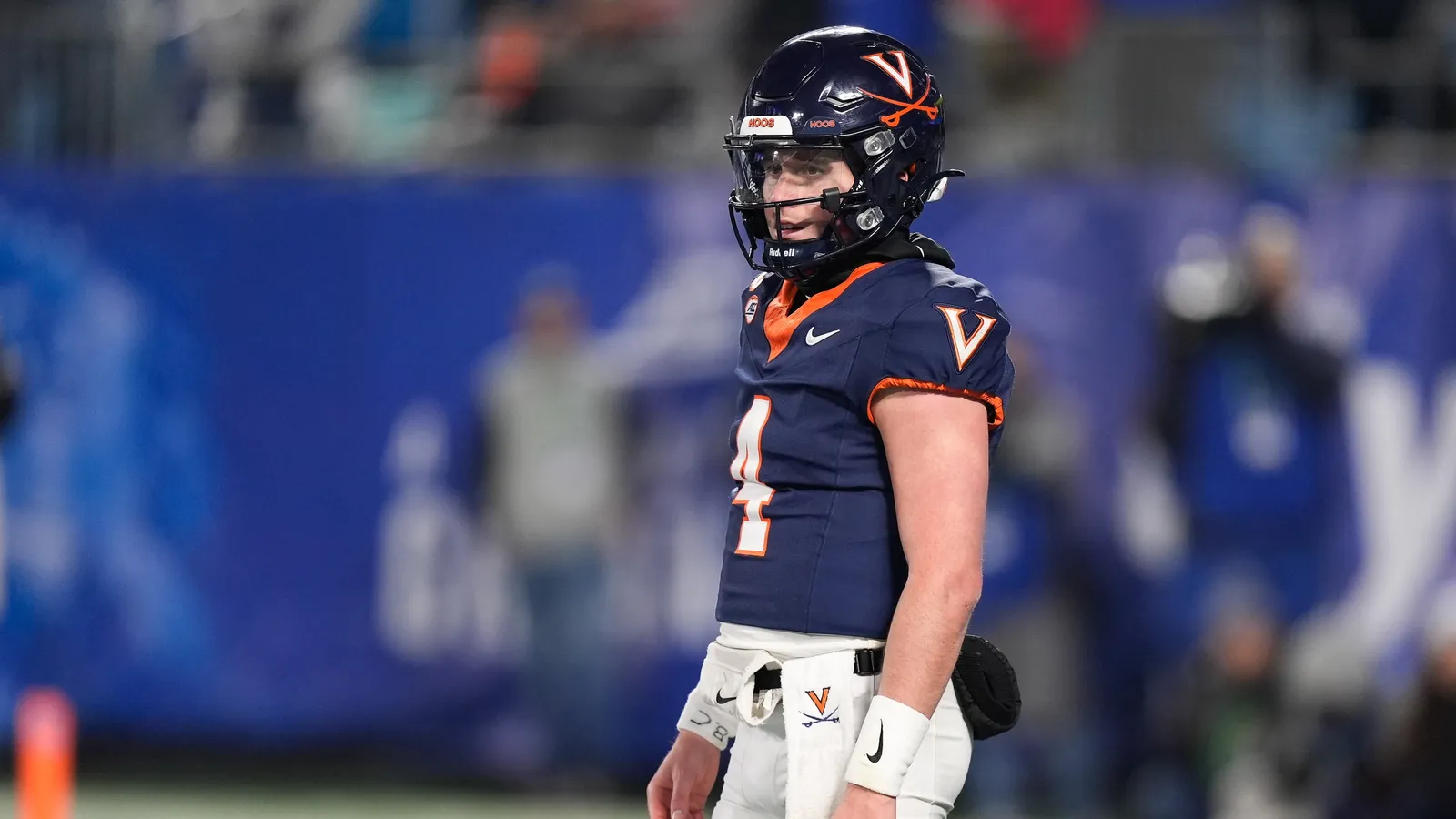
The 2023 season was Chandler Morris's fourth on a college roster but, if his ongoing eligibility lawsuit against the NCAA is successful, it would be the first to count toward his 4-year eligibility.
The son of former SMU and Arkansas head coach (and current Clemson offensive coordinator) Chad Morris, Chandler's career began at Oklahoma in 2020, when he saw spot duty as Spencer Rattler's backup as a true freshman. That was, of course, the covid year and stands as a free pass for everyone. No harm, no foul there. Morris transferred to TCU ahead of the 2021 season and appeared in four games backing up Max Duggan -- taking a redshirt year that no one disputes.
Morris started six games for the Frogs in 2023, all 13 games at North Texas in 2024, and then went 14-for-14 in the starting lineup for Virginia in 2025. No one disputes those seasons as counting toward Morris's eligibility, either.
What stands in question is the 2022 season, and the Morris family is using a novel strategy that, if successful, could open a can of worms as the NCAA tries to keep a lid on its eligibility rules.
The facts of the case: Morris beat out Duggan -- who'd started 29 games over the previous three seasons -- for the starting quarterback job in training camp ahead of the 2022 campaign. He suffered a knee injury in the third quarter of the Frogs' season-opener at Colorado, Duggan moved back into the starting role, and the rest was history. TCU, undefeated in the regular season, reached the national title game. Morris's knee was cleared to play in mid-October, and he returned to action in spot duty -- playing a total of 26 snaps across three games behind Duggan, once again entrenched as TCU's starter.
By the letter of NCAA law, Morris appeared in four games in TCU's 2022 season, counting it as the first of his 4-season eligibility and, thus, making 2025 his last.
The Morrises side of the story: Suffering an injury so soon after winning the starting job devastated Morris mentally and emotionally, and so the Morrises, their sports mental-health specialist named Brian Cain, and TCU crafted a plan to keep Chandler engaged by giving him spot duty once his knee was healthy enough to return to action.
“Having Chandler sit out of the entire season after the injury would have had far more sever(e) negative impacts on his mental health than staying with his team and active in his preparation, giving him a purpose and plan on a daily basis,” Cain wrote in a statement in Morris's lawsuit, filed in Charlottesville Circuit Court, according to documents obtained by The Athletic.
“Chandler confided in me about his physical and mental struggles throughout his time at TCU — especially during Fall 2022, which was an extremely tough season for Chandler,” then-TCU AD Jeremiah Donati said. “Chandler should not be penalized for decisions made in consultation with medical and mental health professionals … when the impact of those decisions could not be fully understood.”
The NCAA's side of the story: “The NCAA will continue to defend against attempts to rob high school students across the nation of the opportunity to compete in college and experience the life-changing opportunities only college sports can create,” the organization said in a statement.
The can of worms: Obviously, the NCAA can't come out and say Toughen up, kid. But to avoid creating a precedent that would open up the floodgates beyond repair, the NCAA legally has to fight Morris's case with an argument that equates to Toughen up, kid.
The NCAA will argue that injuries and the loss of starting jobs, unfortunate as they may be, are just as much a part of college athletics as the scoreboard and referees. The organization's rules give athletes four years to play five. If every athlete got a do-over for each season that did not unfold in something close to ideal circumstances, it would take six, eight, 12 seasons for many athletes to count to four. Chandler Morris is far from the first college athlete to have his career altered by circumstances beyond his control.
Then again, the NCAA can't come out and say that. Crafting a public-relations campaign against Morris would be tricky to put it lightly, and no one in 2026 wants to be seen minimizing a young person's mental health struggles. Some will call Morris heroic for putting his name behind an invisible injury that is no less real because it can't be captured by an MRI.
“They can go in and look at my knee and see, ‘OK, your knee is fine,'” Morris told The Athletic. “But you can’t go inside someone’s head and really see their thoughts. So I think it’s important for me to come out right now and really talk about this.”
Then double again, others will view Morris's argument and say he is cynically trying to use mental health as a shield in order to profit financially through another year in college. He turned 25 in December, and is generously listed at 6-foot-even. Surgery to his non-throwing shoulder has kept Morris out of the combine/pro day circuit. He made a reported $1.5 million for the 2025 season at Virginia, and a 2026 season could be worth double that. While no one knows what the future holds, Morris likely stands to make substantially more playing for Virginia in 2026 than he would at the NFL level.
The reality on the ground: The NCAA cited a lack of documentation surrounding Morris's return to action on Oct. 17, 2022 as its reasoning for denying Virginia's appeal back in January. TCU, along with Morris's specialist Cain, have since provided statements to the courts affirming the playing-time-as-injury-management case for handling Morris's psychological injury.
Morris filed his case in Charlottesville, a strategy used successfully across the country. Just last month, Trinidad Chambliss used home-court advantage and recently-unearthed documentation of a 2022 injury to get a second season at Ole Miss, and it would be surprising if Morris didn't achieve the same outcome at Virginia.
What that means as far as precedent for future eligibility cases? We'll have to wait and see.