
If you're like me and prefer the College Football Playoff remains at 12 teams, we all owe a debt of gratitude toward the Big Ten. If not for commissioner Tony Petitti's hair-brained scheme to double the CFP's size just two years after it tripled from four to 12, the CFP would have grown to an unnecessary 16 for the 2026 season. Every other power broker in college football preferred 16, the Big Ten wouldn't budge off 24, and so the bracket remains at 12. For the time being.
Unfortunately, the Big Ten hasn't stopped pushing for 24, and on Friday ESPN publicized an internal document arguing for 24 teams. There's a lot to unpack here, so let's dive in, Q&A style.
Q: FCS and below all have at least 24 teams, what's the big deal if FBS does the same?
A: Good question, me. In FCS and beyond, the NCAA gives automatic qualifiers to every conference champion. That would not be the case here. Per Pete Thamel: "The 24-team format would comprise the 23 best teams and one spot for the Group of 6." The SEC would have gotten seven teams in a 24-team CFP in 2024, the Big Ten six, the Big 12 five, the ACC three, the Group of 6 two, and Notre Dame.
For more than a century, what separated college football from every other sport is that the regular season was the playoff. The 24-team CFP takes a sledgehammer to that wall. The SEC would get one less than half of its teams into the CFP.
Q: Wait, 23 and one? isn't that language pretty patronizing for the Group of 6?
A: It is. Now, that's Thamel's writing, and it's possible he didn't mean to imply that the Group of 6 couldn't get one team into the top 24 without a special carve-out, but the piece says what it says. For the record, there have been no less than two current G6 teams in the final CFP top 24 every year this decade (which is far as I went back to check.)
Q: What happens to conference championship games?
A: They would go away.
The Big Ten's pitch for 24 over 16 is that the CFP contract is already bought and paid for by ESPN through 2031, with the Worldwide Leader owns the right for all formats of up to 14 teams. So, growing to 16 wouldn't make the juice worth the squeeze, since the CFP would only have two extra games to sell. At 24 teams, there's a lot more inventory for other networks -- i.e., Fox, CBS and NBC, all of whom do not have a piece of the current pie, and all of whom air the Big Ten's games -- to bid on. The thought is that expanding the CFP would create enough new revenue in the system that the Power 4 leagues could absorb the loss of their mostly obsolete, but still lucrative title games.
Q: What would the schedule look like?
A: The first round would begin the second weekend of December, currently Army-Navy weekend. The second round would be on the third weekend, when the CFP begins now, and then everything would continue as normal from there: quarterfinals on New Year's Eve/Day, semifinals the following Thursday/Friday, and the title game in mid-to-late January?
Q: Wait, completely reimagining the entire postseason wouldn't even move the title game up? The one problem everyone in college football agrees on wouldn't even be addressed?
A: Yup. This is the leadership we have in college football.
Q: When would this monstrosity begin?
A: Again, this is all the wish list of the Big Ten. Nothing has been voted upon, and it remains to be seen wether the B1G's dreams become reality. All that established, the CFP would grow to 16 for 2027 and '28, and then grow again to 24 by 2029.
Q: Are there any positives to this thing?
A: Rightly or wrongly, many coaches and ADs have internalized that loss avoidance is the main priority of the selection committee, and so now future home-and-homes like Texas-Notre Dame and Alabama-Ohio State are very much in doubt. Those games would no longer be in jeopardy. The Big Ten's plan acknowledges this:
"In today's transfer portal/player movement era, teams may lose a game or two early and gel together later in the season -- more playoff opportunities late provides an appropriate safety net."
In layman's terms, the "appropriate safety net" means "teams can lose three games and it won't matter."
Again, for 150 years college football had the best regular season in sports. There's a see-saw effect here, where you don't want a postseason that incentivizes teams away from big non-conference games because losing them is too costly, but you also don't want a system where teams treat September like it's the NFL preseason.
Or, at least I don't want that. Clearly, the Big Ten does.
Q: Would you shut up and show me the bracket already?
A: Fine, here it is.
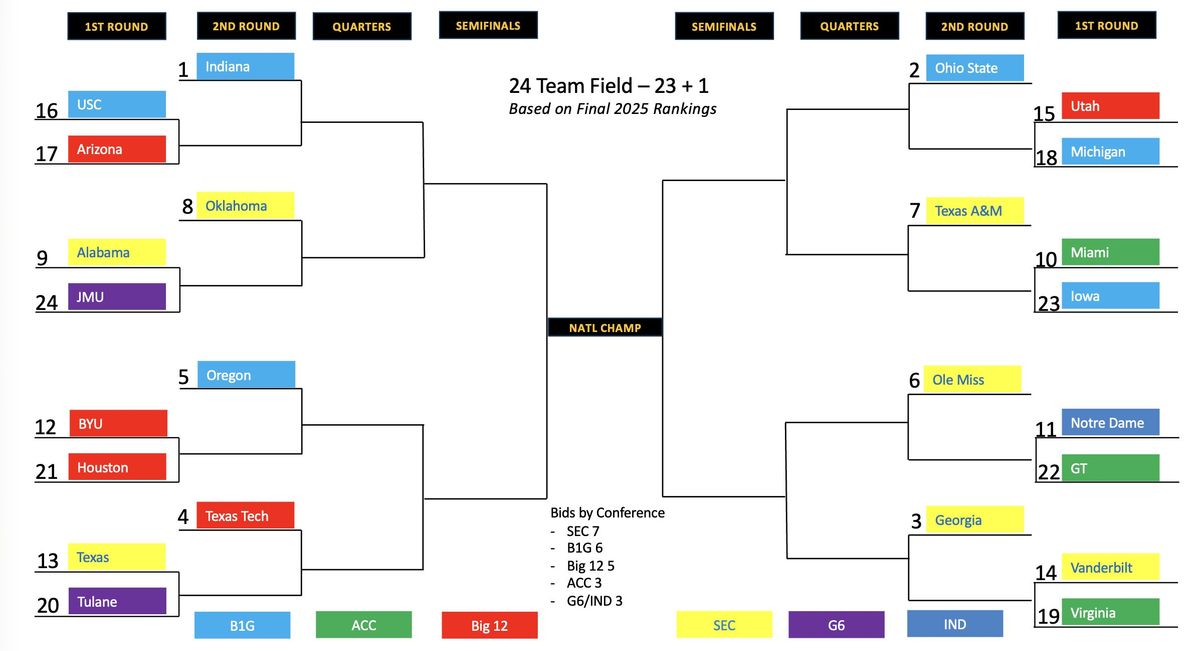
This bracket is designed for teams like Notre Dame and Texas, who improved throughout the season and easily could have gone on Miami-like runs if given the chance, to have that chance. Also included?
-- Iowa, who went 0-4 against ranked teams in the regular season
-- Michigan, who did not beat a team above .500 all season
-- Houston, who lost 35-11 at home in its only game all season against a year-end Top 25 team
-- Georgia Tech, who went 1-3 in November
-- Vanderbilt, the 7th-place finisher in the SEC
Who watched the CFP in December and January and thought to themselves, "Man, this just doesn't feel complete without Iowa and Houston involved."
To quote Nick Saban, Is this really what we want college football to be?