
All's well that ends well, but the 2025 season was nearly a Hindenburg-level disaster for the ACC.
Heading into Conference Championship Weekend, two ACC teams were ranked in the College Football Playoff's Top 25: No. 12 Miami and No. 17 Virginia. And so naturally, the ACC championship pitted No. 17 Virginia against unranked Duke.
That was because the ACC standings looked like this:
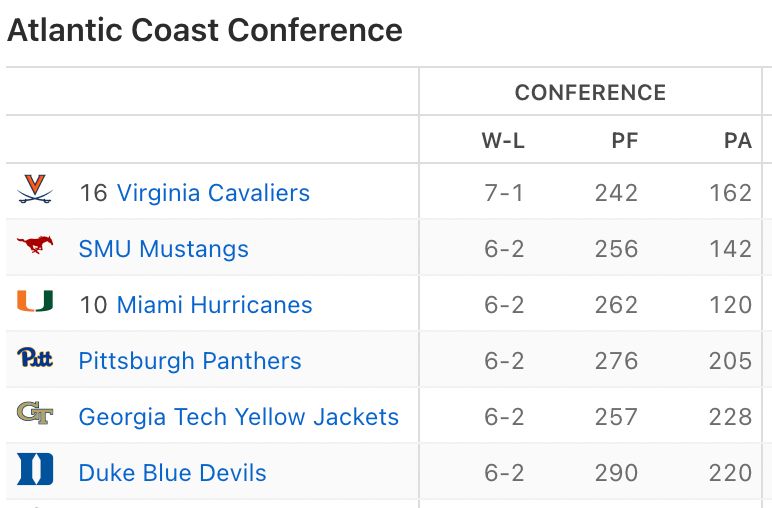
Among the 5-team logjam of 6-2 squads, Duke (0-1) had the worst record within the group, and yet the Blue Devils advanced to Charlotte because their eight ACC opponents had the highest overall winning percentage. Not only did Duke make the ACC title game, Manny Diaz's Blue Devils messed around and won the whole thing, meaning a Power 4 conference woke up on Selection Sunday morning faced with the real possibility that it could miss the 12-team Playoff altogether.
As we know, the selection committee conveniently remembered that Miami beat Notre Dame to open the season and elevated the Hurricanes above the Fighting Irish into the final at-large spot at the last minute, and then Mario Cristobal's team went on a run that nearly ended in a national championship.
Good fortune did not change the ACC's problem. The obvious best move at the time -- a FIFA-style move to replace Miami with Duke in the title game -- was not available, because FIFA is the only sports organization on earth bold and shameless enough to pull it off. And so the ACC had to hold its breath, hope for the best, and promise to never allow this to happen again.
And in a 17-team conference that plays only nine games, something like this was bound to happen again. In fact, in the 2025 season, multi-team logjams existed atop of the standings in five of the nine division-less conferences (the Sun Belt is the lone holdout).
To open its media days on Wednesday, the ACC unveiled a new tiebreaker policy where, essentially, any tiebreaker that can't be broken by a clean head-to-head advantage immediately goes to a modern version of the BCS rankings: SportSource Analytics's Team Success Ranking. This ranking, whose formula is proprietary and thus secret, is provided to the CFP selection committee. In short, the ACC tiebreaker doesn't default directly to the CFP rankings, but it would be a surprise if a team with a higher Team Success Ranking wasn't also higher in the CFP's Tuesday night rankings. Also: using the Team Success Ranking is a matter of logistics, since the TSR can be calculated on Saturday night/Sunday morning, rather than waiting around until Tuesday night for the CFP rankings.
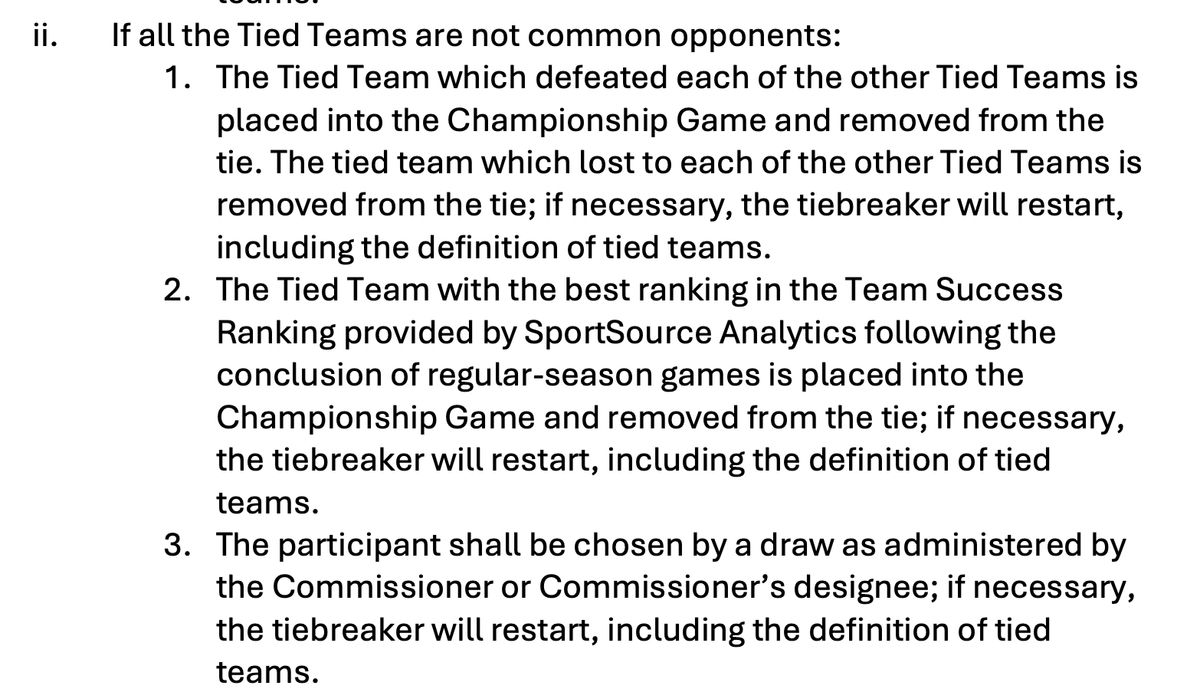
A repeat of the 2025 season would revert to Rule 2, Section ii, Subsection 2. And if that failed, the ACC reserves the right in Subsection 3 to "pull a FIFA" and pick the team it wants in the championship game:
Even though the Duke/Miami Problem has been solved, the ACC's odd structure has still left the league uniquely open to controversy in a way that: A) is likely to happen every single year, and B) cannot be avoided without drastic changes. As a 17-team conference, some ACC teams will play nine conference games each fall, and others will play eight. And in the ACC's eyes, a 7-1 record will be viewed the same as a 7-2 record. An 8-0 team will be viewed as identical to an 8-1 one. The league will see no difference between 6-2 and 6-3.
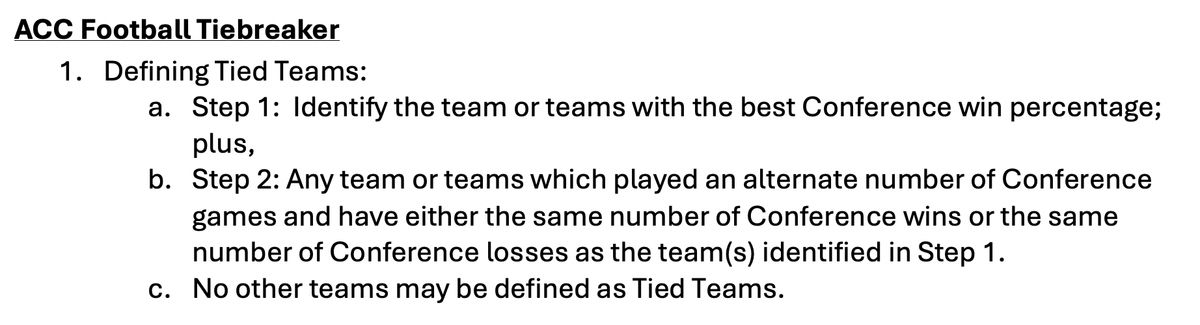
He doesn't know who he is yet, but at least one ACC coach is bound to lose his mind this November when his 7-2 ACC squad misses the championship game for a 6-2 team. And he'll have a great argument.
Update: ACC VP of football Michael Strickland spoke to On3's Andy Staples, who provided some clarification. While a 7-2 team would never go to the ACC title game over an 8-1 team, there is a possibility of a 7-1 team playing in Charlotte over an 8-1 team. More here.