GRAPEVINE, Texas – The first move is to walk 184 steps from the main entrance through a glass-domed atrium, over the mini-river flowing throughout the Gaylord Texan Resort and to the Lone Star Tower elevators.
Here, snag a lift on a lift and choose the predetermined floor – the most hallowed space in all of college football – before exiting and walking an additional 45 steps.
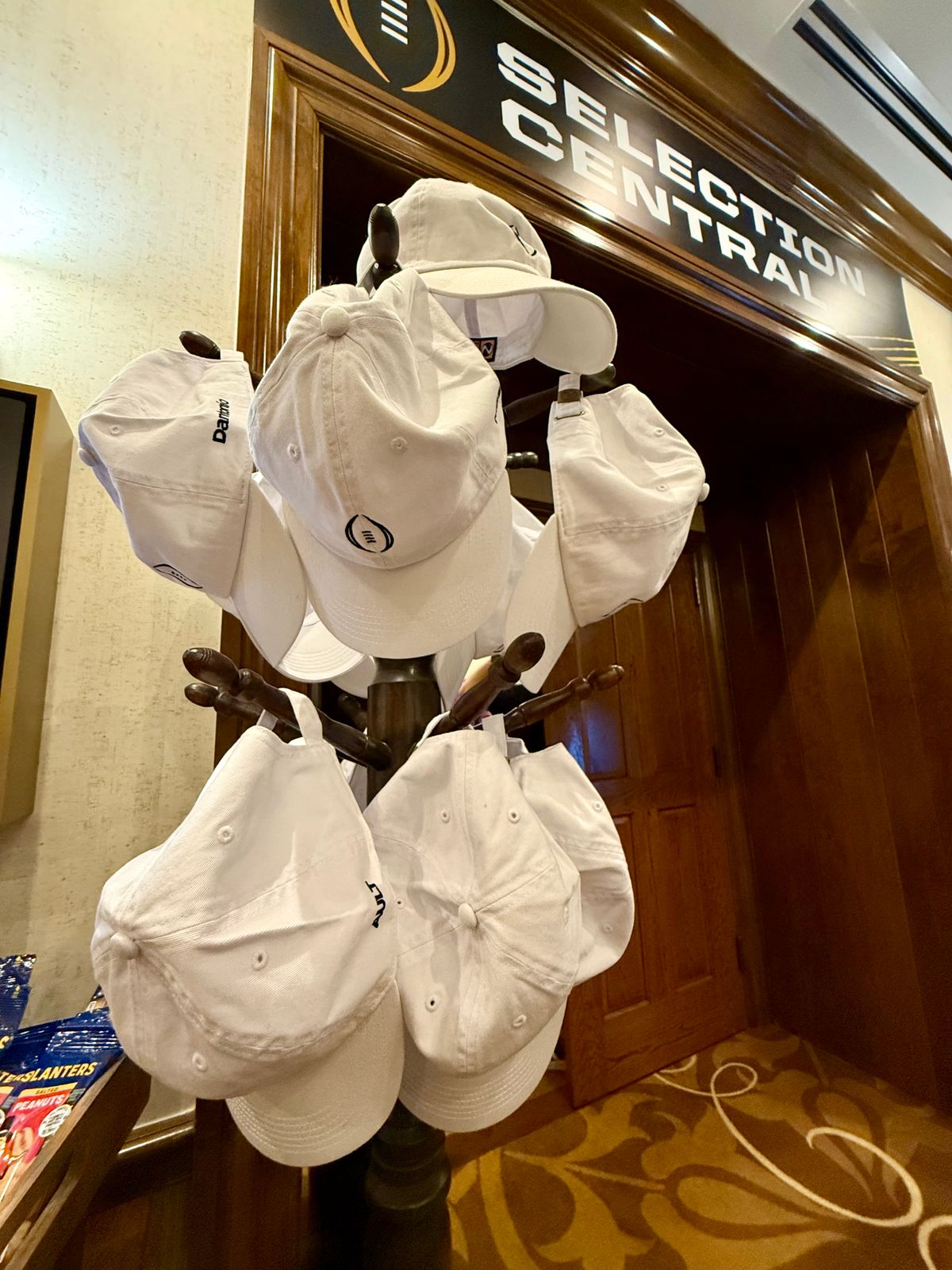
Ditch the hat – real or proverbial – on the custom-carved rack, which Jeff Long long ago commissioned to be custom-carved by someone in the Ozarks during Long’s initial foray as committee chairman.
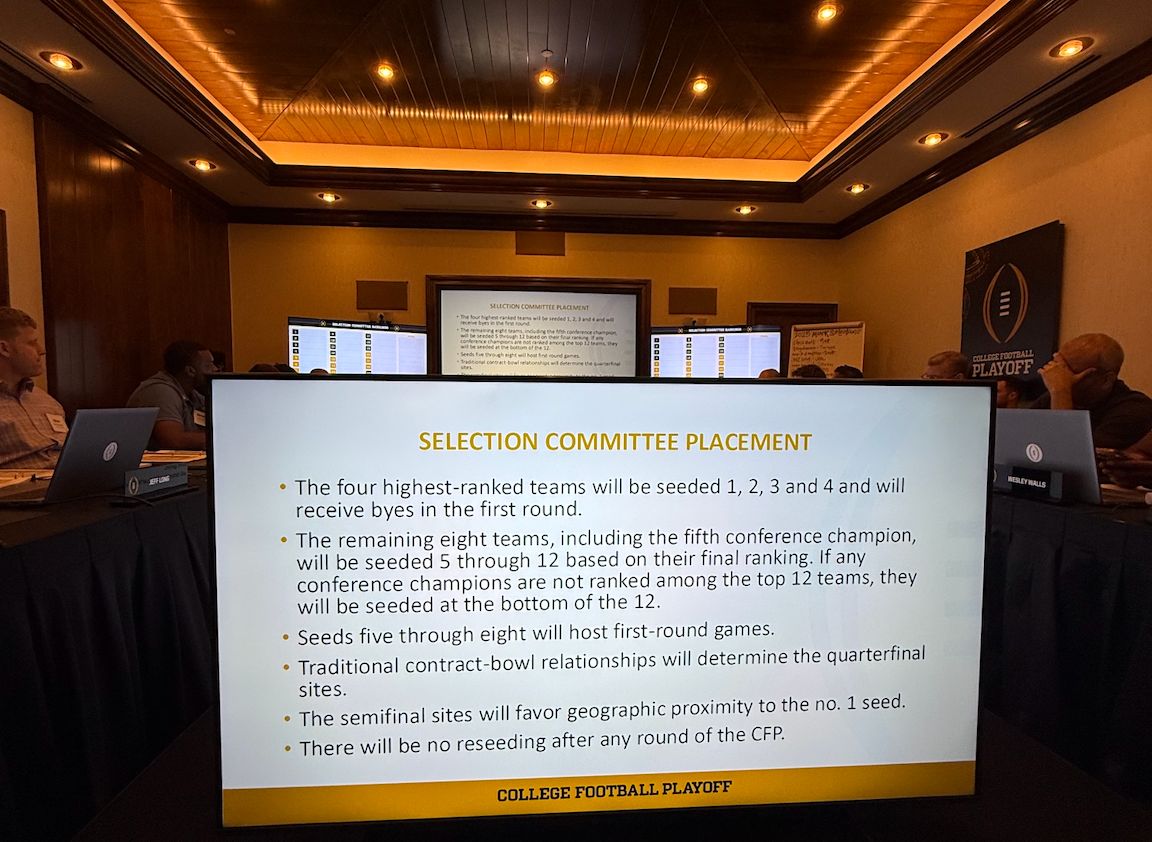
Once inside this mostly obscure, almost-hidden room prepare for the most important task in all of college football: Ranking the teams, today and every Tuesday until the ultimate Sunday in December, that will comprise the College Football Playoff’s top 25 and, ultimately, its 12-team field for the 2025 iteration.
“We picked the hotel because there are tunnels underneath this hotel, and we thought that we would need to be really secretive and bring the committee in and no one would need to see them and whatnot,” said Allison Doughty, a founding CFP employee and its director of events and hospitality services. “We realized very quickly, as you realized trying to find this room, it’s almost impossible to find this room so we didn’t need to do that.
“Again, the hat rack … is where everyone hangs their hat, which really means you’re leaving your bias outside the room. That’s something that they will ceremonially do and then at the end, they do take their hat and it’s kind of a souvenir.”
Personal mementos are the last items on the collective minds of the 13-person CFP Selection Committee, which this year is chaired by Baylor Athletics Director Mack Rhoades and steered by Rich Clark, the CFP’s executive director and a decorated former Air Force Lieutenant General who wrapped his military service as the Academy’s Superintendent.
After its inaugural 12-team field in 2024, which culminated with eighth-seeded Ohio State outlasting No. 7 Notre Dame, the CFP has tweaked its guidelines for Year 2.
FootballScoop, after an invitation to join a dozen or so other media from around college football for a mock-selection process in late September, is taking you inside the College Football Playoff Committee’s Selection Process.
While automatic qualifiers remain for the five highest-rated conference champions, most typically expected to be the four Power Conference champions, as well as the highest-ranked Group of Five title-winner, byes no longer are guaranteed for those teams who win their leagues.
Utilizing this year’s criteria with last year’s data, the 2025 Mock CFP Committee closed its field with No. 1 Oregon, No. 2 Georgia, No. 3 Ohio State and No. 4 Texas.
The remainder of the field was selected as followed: No. 5 Penn State, No. 6 Notre Dame, No. 7 Tennessee, No. 8 Arizona State, No. 9 Indiana, No. 10 Boise State, No. 11 Alabama and No. 12 Clemson.
SMU, an at-large bid-recipient last year and the ACC Championship game runner-up, was voted out of the field and replaced by the three-loss Crimson Tide of then-first year coach Kalen DeBoer.
John Brice/FootballScoop
Hats aren't welcome beyond those doors -- nor is any biased viewpoint.
How, exactly, does the process work?
First, there’s never a point where 25 teams are ranked simultaneously.
Instead, the 13-person committee gets a list of 30 teams under consideration for the top 25 and then begins by selecting its top six teams.
This is done electronically and via an secure, anonymous ballot.
Once those six teams are identified, there is open discussion about the teams – a key component of every single step of the rankings process.
Anyone in the room is free to raise any element for debate.
Anyone in the room is free to request every single data point pertaining to the teams on the screen.
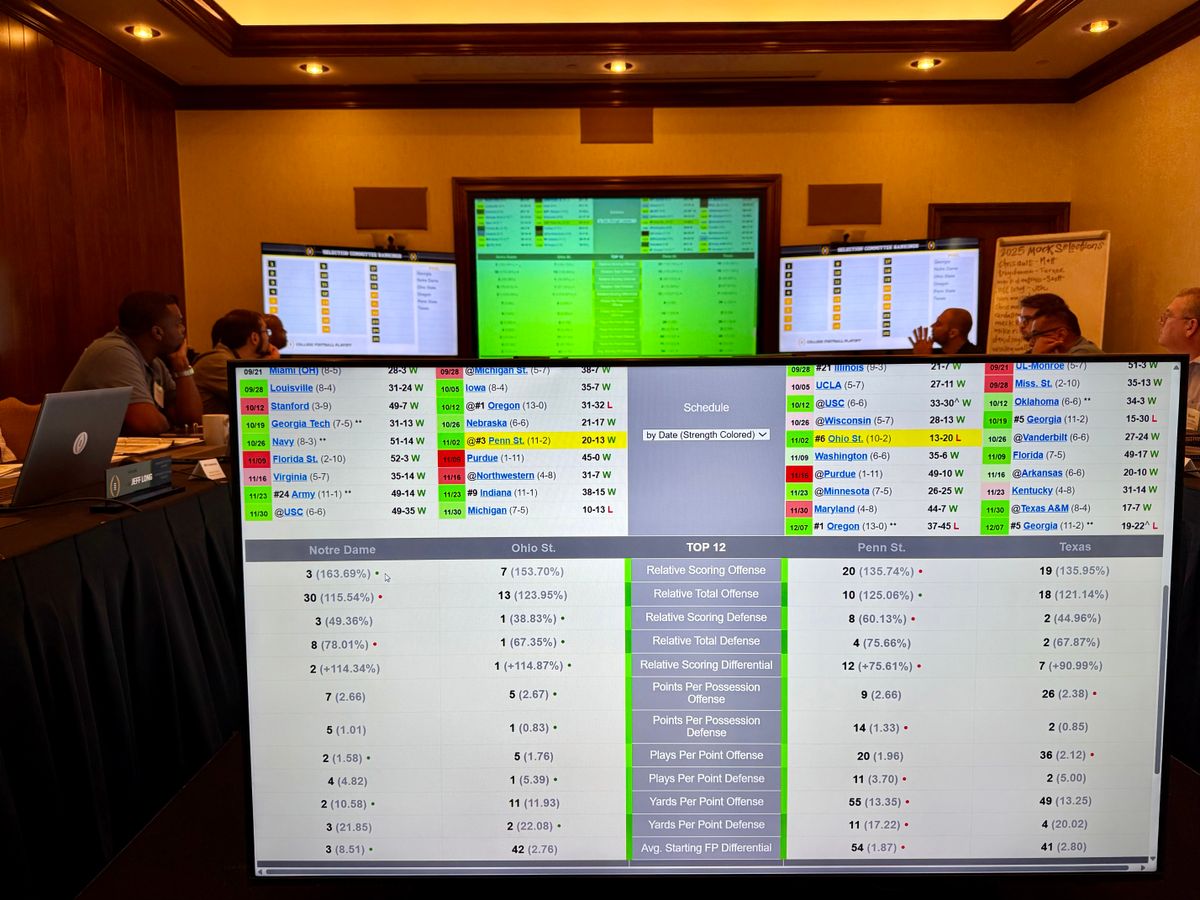
There is a top 12 of metrics that consists of the following:
Relative Scoring Offense
Relative Total Offense
Relative Scoring Defense
Relative Total Defense
Relative Scoring Differential (the cap for a blowout-win is 24 points; an 34-10 win is evaluated the same as a 49-14 win, for example).
Points Per Possession Offense
Points Per Possession Defense
Yards Per Point Offense
Yards Per Point Defense
Average Starting Field Position Differential
John Brice/FootballScoop
Data and analytics are plentiful in evaluating not only teams for consideration in the rankings but also comparing teams in an effort to best rank teams with similar records.
In this exercise, the committee takes a moment to examine Notre Dame, Ohio State, Penn State and Texas against these metrics.
Marcus Freeman’s Fighting Irish have the best relative scoring offense of the quartet at No. 3 in the nation and a 163.69-percent rating. Penn State, in this grouping, is worst at No. 20 and 135.74.
Ohio State, despite its eventual No. 8 seeding in the original but third-ranked by this crew, is the top-ranked team in the sport in the following categories presented to the committee: Relative Scoring Defense, Relative Total Defense, Relative Scoring Differential, Points Per Possession Defense and Plays Per Point Defense. The Buckeyes also are No. 2 in Yards Per Point Defense and rank inside the top 13 on 11 of the 12 metrics; they were 42nd in Average Starting Field Position Differential.
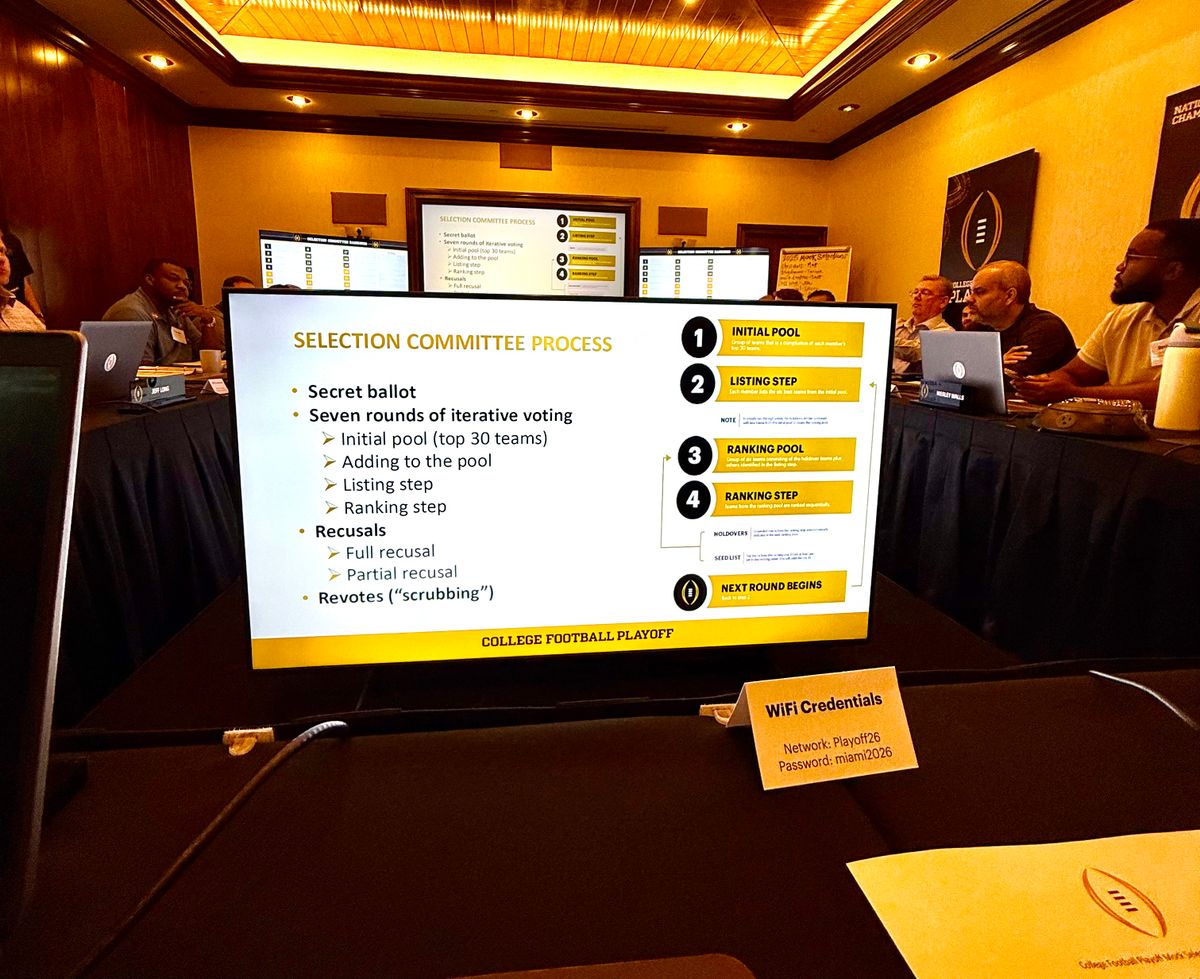
Per CFP protocol for its selection committee members, any individual who has a direct relationship with a school must be fully recused from all discussions and voting about that specific school.
Virginia Athletics Director Carla Williams, for example, will need to abstain tonight from discussions about the ACC-leading, one-loss Cavaliers of Tony Elliott and will be ineligible to vote for the Cavs.
In hosting an array of athletics directors from throughout the NCAA’s Football Bowls Subdivision ranks in the week of also hosting media for the mock exercise, the CFP sought most to illuminate the lengths to which it endeavors to circumvent any inherent biases or conflicts of interest.
“They want to look at the steps that we take and how the discussion is formed,” Clark told FootballScoop. “They’re less concerned, at least at these mocks, of what the actual discussion is, but they just want to understand what the process is. We had various questions about different steps and why we do different things. But in the end, there was nothing really dramatic. Most of them just wanted to have a better understanding so that they could take that back to their conferences and explain it.
“I would just say from a couple of them, they said that they had a lot more confidence in the process after having gone through it. They have a lot more confidence and that they’re glad that they took part in it and that they will take that back to their conferences and try to share what they saw here.”
The deliberations continue into the second grouping of six teams, which includes the previous two not voted into the top and the next four highest-rated vote-getters.
This process is how the CFP Selection Committee ranks its top 16 teams; groups of six, pared down to four.
Once the super 16 are tabbed, the committee takes the remaining teams in groupings of four with three teams voted per time.
It’s this 4-4-4-4-3-3-3 method that delivers the top 25, which will be unveiled for the first time this season tonight from this tiny conference room that houses U-shaped tables and snugly accommodates perhaps 16 people with Clark joining the committee and a couple of additional personnel for the technological components.
There will be four additional Tuesday night rankings before the field is set Sunday, Dec. 7.
Everything focuses on getting the field to its most-deserving dozen.
It is routine for the inhabitants of the “world’s saddest sports bar,” as Doughty terms the TV-laden, alcohol-barren viewing environs, to work into the early-morning hours of that decisive Sunday, snare maybe four to six hours of sleep, and then resume deliberations to seed the final field.
Bring the discussion. Dig the debate. Prepare to defend perspective.
“You can’t hide in the room; everybody sees the discussion that everyone has,” Clark said. “And I believe that the way the voting occurs and the way that the discussions happen, and the opportunity to re-vote if something doesn’t look right, really helps us to eliminate some of that bias. …
“And they come in there with one goal in mind: To rank the top 25 best teams. And they take it seriously, and they take it personally. And I think that’s really the key, having the right people in that room and year after year we’ve gotten great people to be a part of this committee. I am thoroughly impressed with the committee and the people that are on it.”
Clark makes this proclamation mere steps from the elevator where, really, anyone passing by can hear the discussion.
No one does. Not in college football’s most powerful room, cleverly hidden in plain sight.