
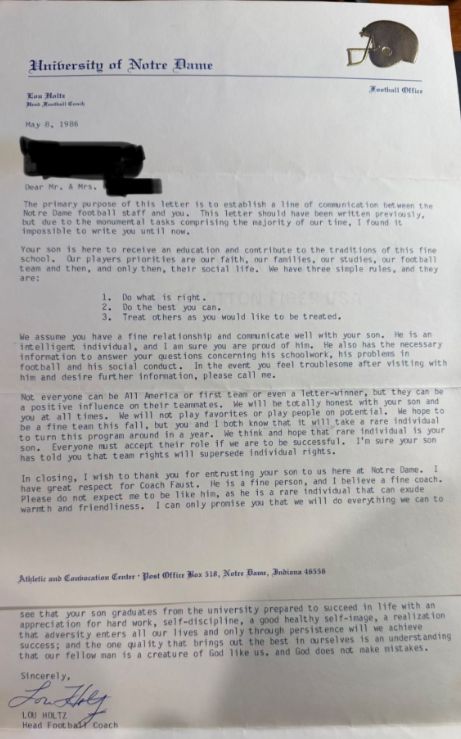
In May 1986, just months after taking over a Notre Dame program that had slipped from its historic perch, Lou Holtz sat down and wrote the parents of his new players. The letter, dated May 8 and shared this week by Holtz’s Heroes Foundation, is not a recruiting pitch or a pep talk. It is a statement of purpose.
Holtz opened by apologizing for the delay. The “monumental tasks” of the job had kept him from writing sooner. Then he laid out what mattered.
Players’ priorities, he wrote, were faith, family, studies, and the football team — “and then, and only then, their social life.” He listed three simple rules: Do what is right. Do the best you can. Treat others as you would like to be treated.
Those lines would become the backbone of his program. They later evolved slightly in public telling — “Do what’s right. Do your best. Show others you care” — but the core never changed. Holtz was telling parents, before a single snap of the 1986 season, that Notre Dame football would be a vehicle for forming men, not merely a scoreboard enterprise.
He was characteristically blunt about playing time. Not everyone would be an All-American, a starter, or even a letter-winner. Everyone could still be a positive influence. The staff would be honest, would not play favorites, and would not play people on potential. Team rights, he reminded them, would supersede individual rights. Turning the program around in one year, he added, would take “a rare individual.” He hoped that rare individual was their son.
Holtz also did something uncommon in a coaching transition: he paid genuine respect to his predecessor. He called Gerry Faust “a fine person, and I believe a fine coach,” then immediately set expectations. “Please do not expect me to be like him,” Holtz wrote, “as he is a rare individual that can exude warmth and friendliness.” The new coach would not try to copy Faust’s style. He would simply do the work.
The letter’s closing is the part that has circulated most widely. Holtz promised parents that the staff would do everything possible to see their sons graduate prepared for life — with an appreciation for hard work and self-discipline, a healthy self-image, and the understanding that adversity comes to everyone and that persistence is the only reliable path through it. The quality that brings out the best in people, he wrote, is the recognition that “our fellow man is a creature of God like us, and God does not make mistakes.”
Two years later Notre Dame went 12-0 and won the national championship. The 1988 team is remembered for toughness, unity, and a refusal to flinch. The seeds of that culture are visible in a letter written when the program was still finding its footing.
Former players have said as much in the hours since the letter resurfaced. Wes Pritchett, an All-American who played on the 1988 title team, wrote that he still reflects daily on how fortunate he was to play for Holtz: “He was a coach of life.” That is the point Holtz was making in 1986. Football was the classroom. The real subject was how a young man would live.
Holtz’s Heroes Foundation, the 501(c)(3) dedicated to preserving the legacy of love, trust, and commitment that Holtz, his players, and his staff exemplified, released the letter this week. It arrives six months after Holtz’s death in March at age 89. The timing feels less like nostalgia than a reminder. The same principles — honesty with players and parents, team over self, character over potential, faith as foundation — remain as relevant in 2026 as they were when a new coach in South Bend first put them on Notre Dame letterhead.
Coaches looking for a model of how to introduce themselves to a roster’s families could do worse than start here. Holtz did not overpromise wins. He promised a standard, a set of non-negotiables, and a view of the young men in his care that began with the conviction that none of them were accidents. God does not make mistakes. The rest, he believed, was up to them — and to the people charged with teaching them how to live it.
Below Coach Holtz wraps it all up in 90 seconds.