
The only thing that could rival being talked about more than the record amount of in-season coaching changes so far this season would be the amount schools are willing to pay to wipe the slate clean for a fresh start with someone new.
In total, about $168 million (with subject to offset and duty to mitigate included in nearly all) is owed to the group of who have been fired up until this point. Atop that list is Brian Kelly, whose $54 million is the second largest buyout in college football history (while it is still being negotiated, it ranks only behind Jimbo Fisher's $75 million figure) and James Franklin's contract at Penn State calls for a whopping $49 million.
There's also Billy Napier ($21 million owed by Florida), Mike Gundy ($15 million owed by Oklahoma State), Sam Pittman ($9.8 million from Arkansas), Brent Pry ($6 million owed by Virginia Tech), as well as $5 million or less for the group of dismissed coaches consisting of DeShaun Foster, Trent Bray, Trent Dilfer and Jay Norvell.
A Republican congressman from Washington is proposing a bill that would not only wrangle the escalating buyouts, but also attack head coaching salaries as well.
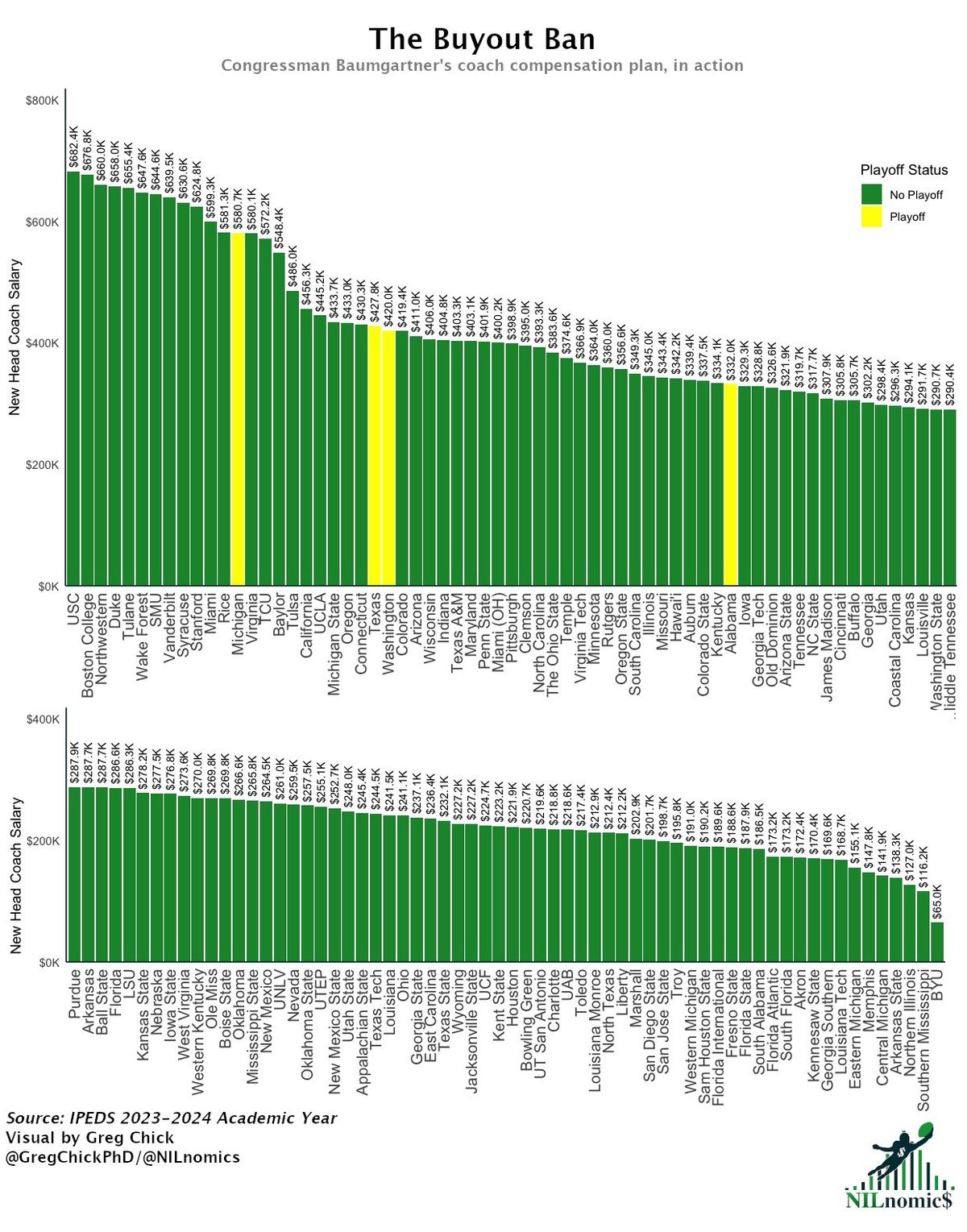
Congressman Michael Baumgartner is pushing the COACH (Correcting Opportunity and Accountability in Collegiate Hiring) Act, which states that athletic department employees would not be able to receive total compensation - including annual salaries and buyouts - that are worth more than 10 times what a school charges in tuition and fees for undergrads in the most recent academic year.
To state his case, Baumgartner took to X, asking why bad college coaches are getting paid $10 million per year?
College sports is not the free market. Colleges are highly subsidized public goods.
— Congressman Michael Baumgartner (@RepBaumgartner) October 28, 2025
Great US military generals make $225,000/yr
Great Supreme Court Judged make $300,000/yr
Great HS Coaches (who also teach) make $100,000 - $150,000/yr
Why do bad college coaches get $10m/yr? https://t.co/kDxtM6RdzL
Using Baumgartner's bill, Brian Kelly's annual pay at LSU would have maxed out at less than $280k per year instead of the $9.5 million he was being paid.
The bill would rewind coaching salaries back where they were back around 1990, and Baumgartner contends that's not unreasonable as college athletics is a "highly subsidized public good," and not the "professional enterprise" it is currently being treated as, in his eyes.
“There is no greater societal benefit to have a coach make $10 million versus $200,000," he shared via Sportico.
"The college sports arms race has really only been to the benefit of people who put roller coasters in locker rooms and high-powered agents for coaches who can overwhelm the abilities and incentive constraints for presidents and athletic directors.”
The likelihood of coaching salaries going from $10 million per year to the couple hundreds of thousands of dollar range are about as likely as a two-loss Group of Five program making it into the college football playoff, but Baumgartner would consider any type of negotiation on reductions to coaching salaries and buyouts a success.
Like the NIL guardrails being pushed through right now, the veteran congressman insists the out of control coaching salaries are something that the government is going to step in and deal with sooner or later.
"Other than my bills, I don’t think there is anything that solves the issue systemically. Whether Congress is dealing with out-of-control college coach salaries this year or some year down the line, eventually Congress is going to have to deal with this issue.”
While many will read this and wonder what creative loopholes can be found to creatively keep coaching pay in the same ballpark it currently is if this were to gain steam, Baumgartner is a step ahead. "Total compensation" would include salary, bonuses, deferred compensation, severance / buyouts, in-kind support, housing / mortage or debt relief, personal services contracts, and other remuneration - from the university of any affiliated or controlled booster organization.
Because social media is so great, someone did the leg work to take a look at what this coaches compensation plan would look like in today's landscape.
Stay tuned to The Scoop for the latest.
Inbox: Rep. Michael Baumgartner has introduced a bill that would provide a limited antitrust exemption to cap college football coaching salaries. pic.twitter.com/VRxHOy7fAE
— Amanda Christovich (@achristovichh) October 27, 2025